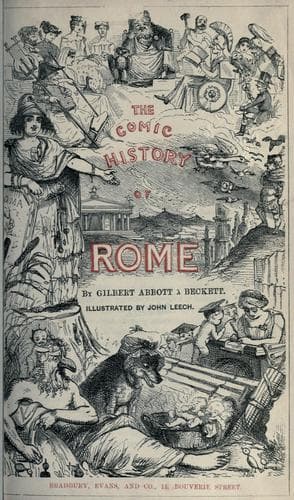
The Comic History of RomeÀ Beckett, Gilbert Abbott
History
The Comic History of Rome
À Beckett, Gilbert Abbott
Rome -- History -- Humor; Wit and humor, Pictorial
It was a fine October morning when the Carthaginian general set out to
cross the Alps by the road over the Little St. Bernard, and after a nine
days' march, which was at that time a nine days' wonder, he reached the
top of the mountain. The fatigue endured by Hannibal and his army cannot
be described, and the toils of the journey were aggravated by the
chance of their falling into the toils and snares of the enemy. Little
passed their lips in the shape of food, and very little passed their
lips in a contrary direction, for they were afraid to speak, lest their
words should disturb the impending avalanche. The way was rugged, save
where it was carpeted by the snow; but even where it was trodden hard
enough to serve as a sort of track or guide, they could scarcely trust
to it, for it gave them the slip every now and then in the most
unsatisfactory manner. On the tenth day they began their descent: and
they, perhaps, little thought at the moment that in quitting the top of
the Alps they were coming down to posterity. The two first days slid
away merrily enough over the ice and snow, but on the third they arrived
at a point where the ground had slipped out of its place, and left to
the enterprising travellers a far from eligible opening.
The shifting of the earth had, in fact, put them to the most perplexing
shifts, for the old road had perversely gone out of its way to baffle
the travellers, and lay at the distance of 1000 feet below them. As
Hannibal looked down upon the chasm, his spirits fell for a moment; but
he speedily rallied, and determined, rather than allow his army to
perish with cold, that he would make a way with them. Nature, however,
opposed him by means of a mass of rock; and as he and Nature were at
variance, he began to think how he could best split the difference. How
he made his way cannot be confidently stated, though several of the
learned,[49] who have gone deeply into the subject, have come out of it
in opposite directions; and the authorities cannot be said to clash, for
they are as wide apart as possible. Tradition, who never fails to take a
trenchant way of getting through a difficulty, settles the point at
once, by attributing to vinegar the success of Hannibal's scheme; but
the vinegar must have been sharp indeed to have cut asunder the rocks
which barred the progress of the illustrious traveller.
It is difficult, also, to conceive how he could have carried with him
the liquid in sufficient abundance to enable him to accomplish the
object he had in view, and we are inclined to the belief that it was by
continued assiduity, rather than by a mere acid, that the wondrous task
was effected. A good-sized cruet full of vinegar would produce no
impression on a common pebble, and when we imagine how many hogsheads
after hogsheads must have been necessary to moisten the rocks through
which Hannibal passed, it can only be the sheerest pig-headedness that
would still obstinately adhere to the supposition we have stated.
Public-domain text, read in full here on John Shaqi.
Reviews
Reviews
No reviews yet
Be the first to share your thoughts on this work.
Elsewhere in the archive
Join the Discussion
Join the discussion
Sign in to leave a comment or review.
Sign InorCreate an account