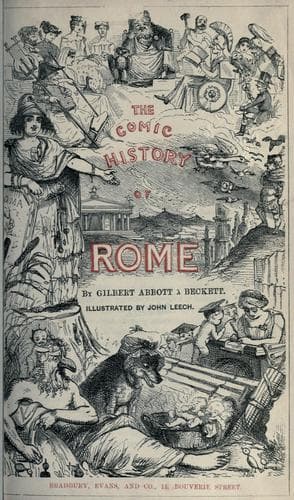
The Comic History of RomeÀ Beckett, Gilbert Abbott
History
The Comic History of Rome
À Beckett, Gilbert Abbott
Rome -- History -- Humor; Wit and humor, Pictorial
On the news of Hannibal's victory reaching Rome, the prætor announced
the distressing circumstance to a numerous meeting of the people, who,
in the absence of the Consul, took upon themselves to appoint a
dictator. Q. Fabius Maximus was chosen, and the mastership of the horse
was conferred on M. Minucius. Hannibal was expected at Rome, but, like a
wise general, he defeated general expectation, and proceeded to
Spoletum, a Roman colony, which he hoped would have held out great
advantages; but it held out with great spirit against him. Wishing to
avoid the inconvenience of a siege, and of sitting down before the city
with nothing but a marsh to sit down upon, he marched into Picenum,
which contained abundance of everything necessary for the support of his
army. His soldiers were afflicted at this time with a cutaneous disease,
and, though this annoyance was only skin-deep, he feared a general
breaking-out, if he had detained them against their will in an unhealthy
country. From Picenum he passed into Apulia; and though he was
disappointed in the hope that the inhabitants would join him, they were
too weak to resist, and he turned every Italian city into an Italian
warehouse for the supply of the comestibles he required. The dictator
Fabius followed at a short distance, but always taking the high ground,
by hovering about the hills and keeping the upper hand of Hannibal.
His intention was to proceed to Casinum, but by some stupid
misunderstanding, the general led the way to Casilinum, and the result
was, that Fabius got ahead of him. On the mistake being discovered by
Hannibal, he got 2000 oxen--but where he got them from does not exactly
appear--and, having procured several thousand bundles of wood, he tied
them to the horns of the animals. Having set the wood on fire, he turned
the oxen out among the Romans, whose quarters soon were thrown into the
sort of confusion prevalent in a London thoroughfare on a Smithfield
market-day. In order to inflame the oxen, their horns had been covered
over with pitch, which gave them an inclination to toss, and the poor
creatures were running about in all directions, under the influence of
fear and fury. Fabius is said to have mistaken the cattle for the
Carthaginians, and to have rushed forwards, sword in hand, resolved on
butchery. The Romans were thus drawn out of their favourable position,
and Hannibal slipped into it, leaving the bulls to decide by a toss-up,
if they pleased, the chances of victory over their aggressors. On the
mistake being discovered by Fabius, he backed out as well as he could,
and ventured on a few skirmishes, in which he met with some success, but
he continued his policy of trying to tire out the enemy.
Public-domain text, read in full here on John Shaqi.
Reviews
Reviews
No reviews yet
Be the first to share your thoughts on this work.
Elsewhere in the archive
Join the Discussion
Join the discussion
Sign in to leave a comment or review.
Sign InorCreate an account