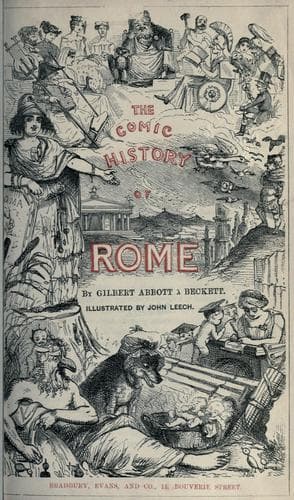
The Comic History of RomeÀ Beckett, Gilbert Abbott
History
The Comic History of Rome
À Beckett, Gilbert Abbott
Rome -- History -- Humor; Wit and humor, Pictorial
The plan he adopted was to continue always in an imposing attitude but
to be ready to slip away, so that, when his antagonist gathered up his
strength to make a hit, the force was always expended on vacancy. The
Romans grew extremely impatient of a series of tactics which showed no
immediate result; and Fabius, having occasion to return to Rome, was
insulted by having the epithet of Cunctator, the dawdler, or the
slow-coach, applied to him. One of the tribunes even went so far as to
charge him with treachery; to which he made, what is usually called, the
"noble" reply, "Fabius cannot be suspected."
It seems to have been extremely easy to get a reputation for "noble"
replies among the Romans, since the mere denial of a charge, amounting
to the commonplace plea of "not guilty," is frequently cited by the
historians as a noble reply, because an individual in a toga happens to
have uttered it. For the purpose of annoying Fabius, or the "slow
coach," the people conferred on Minucius, who, for the sake of
distinction, may be appropriately termed the "fast man," an equal share
of power with the dictator himself, and half the command of the army. On
the return of Fabius to the camp, Minucius proposed that they should
command on alternate days, a course that would have been extremely
inconvenient; for if Minucius had ordered the army to take a week's
march, it is possible that on the day ensuing, Fabius would have ordered
the army back again. The latter, therefore, proposed that each should
take a separate half; but an army, like a house, cannot be divided
without weakness being the inevitable consequence. The ill effects of
the separation were soon shown; for Minucius, who was hot and hasty, was
soon provoked by Hannibal to make an attack, and the Carthaginian
general, who had been accustomed to talk of the Romans hanging over him
like a cloud, declared that they had now come down upon him in a weak
and watery shower. Minucius and his army would certainly have been
absorbed, or, to use a more powerful figure, they would have been
effectually wiped out, but for the generous intervention of Fabius. The
latter saved the former from destruction, when Minucius, who was no less
mawkish than rash, followed up the allegory of the rain by bursting into
tears, and throwing himself on the neck, as well as on the generosity,
of Fabius. Minucius resigned the dictatorship into the hands of his
colleague, who leisurely wound up the campaign; and having resigned his
power, has to this day reigned supreme as the example of the
slow-and-sure principle in the theme of every schoolboy.
[Illustration]
Public-domain text, read in full here on John Shaqi.
Reviews
Reviews
No reviews yet
Be the first to share your thoughts on this work.
Elsewhere in the archive
Join the Discussion
Join the discussion
Sign in to leave a comment or review.
Sign InorCreate an account