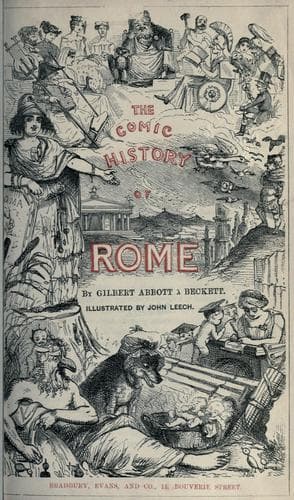
The Comic History of RomeÀ Beckett, Gilbert Abbott
History
The Comic History of Rome
À Beckett, Gilbert Abbott
Rome -- History -- Humor; Wit and humor, Pictorial
[51] Polybius says nothing about the origin of Varro; and as there was
no directory in those days, we are unable to decide whether the omission
of Polybius, or the assertion of Livy, is more to be relied upon.
CHAPTER THE EIGHTEENTH.
CONCLUSION OF THE SECOND PUNIC WAR.
Hannibal was now strongly urged by one Maharbal, the commander of the
cavalry, to march against Rome, and the gallant general went so far as
to promise that if he had permission, he would go and take it so easy,
that in five days they might sleep in the Capitol. "The idea is indeed a
good one," said Hannibal, with an incredulous smile, "but the only
objection to its being carried out, is that it's utterly impossible."
Maharbal persevered in his recommendation; but finding his advice
rejected, he grew sententious and sentimental, which is often the effect
of a snubbing. "Alas!" he exclaimed, with that anti-colloquial style of
expression, which characters in history--but not in real life--are so
fond of assuming,--"Alas! thou knowest how to gain a victory, but thou
knowest not how thou oughtest to use thy victory when thou hast gained
it." If this was the ordinary mode in which Maharbal expressed himself,
it is not surprising that Hannibal preferred his deeds to his words, the
use of his sword to the abuse of his tongue, and his hand in war to his
advice in council.
The object of Hannibal had been to attach to himself the Italian towns,
but they naturally repudiated an attachment, which consisted in his
fastening himself on to them with an army which they were made to
support at a ruinous sacrifice. He had, however, succeeded in winning
over Capua to his designs, for it was inhabited by a contemptible race,
who lay continually in the lap of luxury, where the lapse of all the
better qualities would seem to be unavoidable. Not satisfied with
treachery to the parent state, the Capuans added cruelty to their other
vices, and stifled in their hot baths all the Romans who were living
among them--an enormity which sends the blood immediately to boiling
heat, to contemplate. The faithless inhabitants stipulated that they
should be allowed to break all their engagements with Rome, on entering
into new engagements with Carthage,--an arrangement like that of a
dishonest servant, who, having robbed a former master, stipulates for
impunity for past roguery as the condition of future fidelity. Hannibal
was weak or politic enough to enter into terms with this contemptible
set; but he incurred the unfailing penalty of wrong, for his own army
became corrupted by contact with the Capuan crew, and his fortunes began
to decline from the time of his alliance with this degraded people.
Public-domain text, read in full here on John Shaqi.
Reviews
Reviews
No reviews yet
Be the first to share your thoughts on this work.
Elsewhere in the archive
Join the Discussion
Join the discussion
Sign in to leave a comment or review.
Sign InorCreate an account