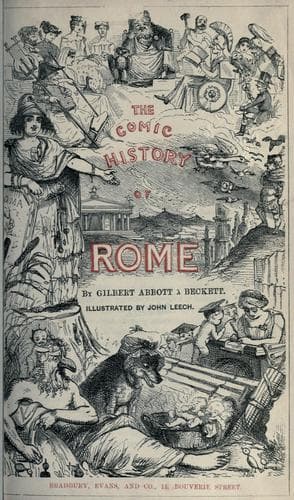
The Comic History of RomeÀ Beckett, Gilbert Abbott
History
The Comic History of Rome
À Beckett, Gilbert Abbott
Rome -- History -- Humor; Wit and humor, Pictorial
Among other instances of gross popular delusion which occurred about
this time, was the sending of Fabius Pictor as ambassador to Delphi, to
consult the Oracle. Fabius was the historian of his age, and was
supposed, therefore, qualified to record all sorts of falsehood; for
history in those early days had not been dignified by that conscientious
accuracy which is in our own time indispensable. His second name of
Pictor was acquired rather by his industry as a house-painter, than by
his talent as an artist, for he had done the whole of the painting of
the Temple of the Goddess of Health; and he probably devoted himself
rather to the pound-brush than the pencil. As a writer of history, there
was something of the painter in his labours; but he was unfortunately in
the habit of employing very false colours. On his return from Delphi,
the public seemed to have derived very little instruction from his
journey; for the sacrifice of two pairs of human beings, a male and
female Greek, and a male and female Gaul, was the principal result of
the information he brought home with him.
As it may be interesting to the student to be told how the Oracle was
worked in those days, we furnish a few particulars. The office for
making inquiries of the Delphic Oracle was in the Temple--dedicated to
Apollo--where a fire was continually burning, fed with the wood of
laurels, which typifies the ever-greenness that deception lives upon. In
the centre of the Temple was a small opening which emitted intoxicating
smoke, and, as the Pythia sat immediately above it, she was rapidly
reduced to a state in which she fell on the floor and uttered incoherent
sounds, which were said to be inspired. A prophet was in attendance to
write down the pith of what the Pythia was supposed to say, and the
purport of these drunken ravings was accepted by nations and individuals
as a guide to their conduct in cases of the most serious interest.
Originally the Pythia was always a young girl, but, subsequently, a law
was passed, limiting the office to those who had passed their fiftieth
year; and there is no doubt that intoxication being the chief duty,
rendered the place peculiarly eligible to the old women. At first there
had been only one female employed, but when the business increased, a
second, and subsequently a third, was appointed, so that there might
always be one at hand to perform the duty, while the other was drunk and
incapable. Of course, a fee was exacted from all who came to consult the
Oracle, which was entirely in the hands of a few aristocratic families
of the place, who made a double profit, by taking money, and giving only
such advice as was calculated to promote their own class interests.
FOOTNOTES:
[49] See the "Course of Hannibal over the Alps ascertained," by
Whittaker, London, 1794, 2 vols. 8vo.; and "A Dissertation on the
Passage of Hannibal over the Alps," by Walsham and Cramer, Oxford.
[50] Polybius, 3. Appian, c. 316. Livy, 22.
Public-domain text, read in full here on John Shaqi.
Reviews
Reviews
No reviews yet
Be the first to share your thoughts on this work.
Elsewhere in the archive
Join the Discussion
Join the discussion
Sign in to leave a comment or review.
Sign InorCreate an account