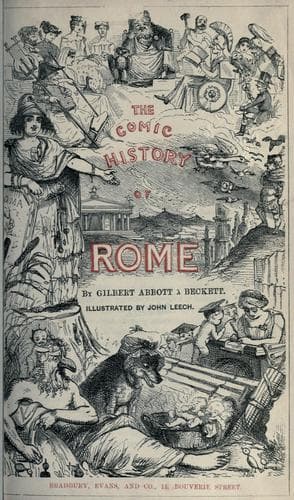
The Comic History of RomeÀ Beckett, Gilbert Abbott
History
The Comic History of Rome
À Beckett, Gilbert Abbott
Rome -- History -- Humor; Wit and humor, Pictorial
This period is rendered additionally remarkable by the siege of
Syracuse, which eventually fell into the hands of M. Claudius Marcellus,
whose efforts had long been thwarted by the genius of Archimedes. This
illustrious inventor lived to the good old age of seventy-five; but how
he lived so long is a matter of almost as much wonder as some of his
inventions, for his biographers tell us that he always forgot to eat and
drink; nor could he ever be persuaded to take a bath, except when his
friends pushed him into one. Even when this was accomplished, he was
sure to be found under the ashes of the fire-places, writing problems
among the cinders, and endeavouring to sift some important point; so
that a bath was really thrown away upon the great philosopher. In a
visit to Egypt, he became anxious to elevate the Nile to a certain
point; but he remained in Egypt until all his money was spent, for the
philosopher had never thought of raising the wind while intent on
raising the water. He invented a screw, which still bears his name; but
he is said to have amused himself, during the siege of Syracuse, by
sitting at the window and inventing all sorts of missiles to hurl at the
ships of the enemy. One day he might be seen throwing stones from a
newly-invented sling, and a few days after he was found casting out
chains, to pull--with a tremendous hook--the ships of the foe completely
out of the water. He was so intent upon everything he came near, that he
gave a lift to enemies occasionally as well as to friends, as in the
instance just recorded, and he declared his ability to give the whole
world a lift if he could only find a convenient spot in the
neighbourhood for himself and his lever to rest upon. That in one sense
he carried out his boast, we are willing to admit; for he undoubtedly
elevated the world by raising the standard of science, and he exalted
the whole of civilised humanity by his great discoveries. The part he
took in the siege of Syracuse has been underrated by some, and
exaggerated by others; for though the story of his pulling the ships out
of the sea requires a length of rope, and other apparatus, which none
but the greatest stretch of imagination can supply, his destroying the
vessels by burning-glasses is perfectly credible. He is supposed to have
used very powerful reflectors, capable of taking effect within the
distance of bow-shot; and though for some time the moderns insisted that
the long-bow had been pulled for the purpose of increasing the space,
the powers of the burning-glass are now familiar to every schoolboy.
On the fall of Syracuse, orders were given by Marcellus, the Roman
general, that the philosopher should be respected; but he was so
absorbed in a problem, that the soldier who was sent after him not being
able to solve the problem of who he was, or what he was about, fell upon
and slew him.
Public-domain text, read in full here on John Shaqi.
Reviews
Reviews
No reviews yet
Be the first to share your thoughts on this work.
Elsewhere in the archive
Join the Discussion
Join the discussion
Sign in to leave a comment or review.
Sign InorCreate an account