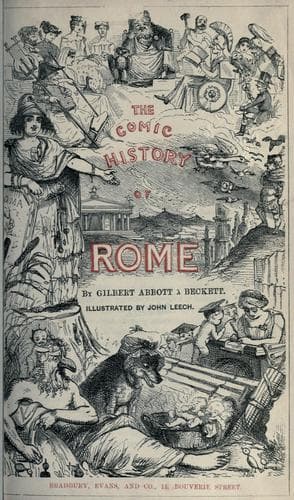
The Comic History of RomeÀ Beckett, Gilbert Abbott
History
The Comic History of Rome
À Beckett, Gilbert Abbott
Rome -- History -- Humor; Wit and humor, Pictorial
It is of the great man we have been noticing that a story is told, which
proves that the pursuit of the laws of gravity may sometimes be
associated with the ludicrous. King Hiero, of Syracuse, had handed over
a good lump of pure gold to a working jeweller to be converted into a
crown, with the distinct understanding that the true metal only should
be used, and that there might be no alloy to the pleasure his Majesty
would feel in wearing it. The goldsmith brought back an article of the
proper weight; but the king, after trying it on his head, turning it
over in his mind, and revolving it beneath his eyes in the sun, declared
his suspicion that the metal had been tampered with, and a base
imposition had been practised. He consulted Archimedes as to the means
of detecting the imposture; and on one of those days when the friends of
the philosopher had forced him to take a bath, he became immersed as
deeply in speculation as in the water.
The bath into which he plunged having been full to the brim, the
apartment was soon flooded by the water he displaced; and looking at the
wet floor, he thought only of the dry facts of science. It occurred to
him that any body of equal bulk would have done exactly the same thing;
and he immediately thought of his royal master's crown, which, if all
the gold sent for its construction had been fairly used up, should
displace as much water as a piece of pure metal equal in weight to that
which the crown ought to contain. The moment the idea struck him he
jumped out of the bath, and thinking of nothing but the bare facts, he
ran through the streets, perfectly unconscious of the naked truth of his
own condition. His shout was εὕρηκα[52]--I have found it; but everybody
thought, when they saw him, that whatever he might have found, he had
certainly lost his senses.
[Illustration: Archimedes taking a Warm Bath.]
There is, no doubt, much exaggeration in the absurd stories told of
Archimedes; but we may excuse a little oddness in a great man whom none
was even with. He ran so far in advance of his age, that eighteen
centuries had nearly elapsed before any one came up to him, and then it
was chiefly by following the track marked out by his footsteps.[53]
We must now leave the nobler instruments of science, to return to the
engines of war, which were as usual in full play, and had been employed
in the total dissolution of the already too dissolute city of Capua. The
dissipated nobles, palsied by their excesses, and paralysed by their
fears, fell by their own hands; for they had neither the courage to
fight for the chance of success, nor the nerve to meet the consequences
of failure.
Public-domain text, read in full here on John Shaqi.
Reviews
Reviews
No reviews yet
Be the first to share your thoughts on this work.
Elsewhere in the archive
Join the Discussion
Join the discussion
Sign in to leave a comment or review.
Sign InorCreate an account