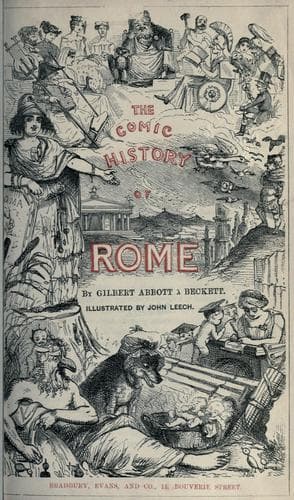
The Comic History of RomeÀ Beckett, Gilbert Abbott
History
The Comic History of Rome
À Beckett, Gilbert Abbott
Rome -- History -- Humor; Wit and humor, Pictorial
The campaign was opened by P. Sulpicius Galba, who crossed the Adriatic,
but did little, and was succeeded by Villius Tappulus, who did nothing.
Fortune had hitherto observed a sort of stiffness towards both sides,
leaning neither to the right nor to the left, when she suddenly took a
turn under the consulship of T. Quinctius Flaminius. This individual
was, comparatively, young in years, but superlatively old in cunning;
and he possessed in an eminent degree the low arts of deceit which are
usually held to constitute the high art of statesmanship. He could
electrotype falsehood with the external appearance of truth, and he had
no lack of that lacquer which brazens out a fraud with the brass of
impudence. Everything in the shape of rust had been rubbed off his
manners, which had become smooth in the extreme, and had acquired that
high state of polish which is frequently associated with a very slippery
character. He slid, as it were, into the confidence of all, with the
easy lubricity of the serpent, and with not a little of its wiliness.
His smile won, or rather lost, those whom he wished to deceive, and he
tried its fascination with such effect on some of the Greek chiefs, that
they permitted him to enter Thebes, and either did not see what he had
in his eye, or were induced to wink at it. He pretended that he wished
to parley with the authorities; but, when the citizens were waiting to
see what would take place, they found the place itself quietly taken by
Flaminius.
Thessaly now became the scene of war, and the Romans met the Greeks near
a line of small hills, called, from their shape, the Dogs' Heads, or
Cynocephalæ. Here both parties fought with a dogged obstinacy, which was
quite in character with the place, until the Greek phalanx, or
Macedonian heavies, gave way before the Roman legions. The principle of
the phalanx was to pack the soldiers so closely together that their
shields touched, and their spears being upwards of twenty feet long, the
arms of the rear ranks leaned on the shoulders of those in advance, so
that they went forth arm in arm, as it were, to meet the enemy. The
Romans, on the contrary, preserved a sort of open order, in which there
was room for the exercise of their limbs; while the Greeks, if they were
able to raise their arms at all, were very likely to lift them against
each other. If the Romans were in need of assistance, there was space
left in their ranks for reinforcements to come up. But, amidst the
density of a Greek phalanx, nothing could make its way except a panic,
which will always find room to run through an entire army. Though
presenting, by these means, a formidable front, their line was no sooner
broken than they offered a most unprotected rear to an active foe, and
the Greek files on the occasion in question bore marks of a special
endorsement at the hands of the Romans. Having been packed as closely as
cards, 8000 Macedonians fell upon the field, or rather upon one another,
Public-domain text, read in full here on John Shaqi.
Reviews
Reviews
No reviews yet
Be the first to share your thoughts on this work.
Elsewhere in the archive
Join the Discussion
Join the discussion
Sign in to leave a comment or review.
Sign InorCreate an account