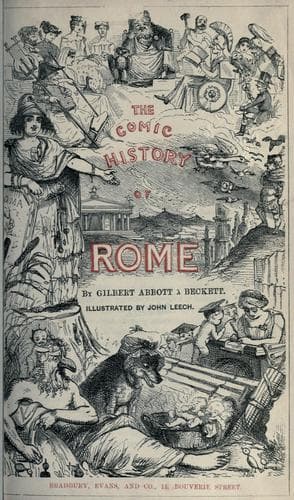
The Comic History of RomeÀ Beckett, Gilbert Abbott
History
The Comic History of Rome
À Beckett, Gilbert Abbott
Rome -- History -- Humor; Wit and humor, Pictorial
While matters were in this state, Hannibal was living in scarcely any
state at all, as an ordinary member of the Carthaginian Senate. He had
taken the opposition side of the house; and though he was a proposer of
many useful reforms, he was frequently coughed down, and in a minority
always. Finding little sympathy amongst his own countrymen, who were all
for peace and quietness, he entered into a negotiation with Antiochus,
for the purpose of ascertaining whether they could arrange to create a
joint disturbance, and thus weaken the Roman power. Treachery was,
however, going on in all directions; for, while Hannibal was plotting
with Antiochus against Rome, some of the Carthaginians were plotting
with Rome against Hannibal; and a further breach of trust in some other
quarter made him acquainted with his danger. He accordingly resolved to
escape; and having a small tower--or marine residence--on the coast, he
sent orders that a ship should be ready to sail, and a berth secured for
him. He walked about the streets of Carthage all day, as if nothing had
happened, and nothing was likely to occur; for the Roman ambassadors
were continually dogging his footsteps; and he led them about so
perseveringly all day, that when the evening arrived they had scarcely a
leg to stand upon. Hannibal had, however, ordered his horse, which flew
with him across the country to the spot where the ship was in waiting;
and, after a difficult passage, by land as well as by sea, he arrived at
the Court of Antiochus.
True to his infantine oath, Hannibal did his utmost to excite hostility
against the Romans; and asked Antiochus to lend him a trifle, in the
shape of 10,000 men, as if they were so many counters, that the game of
war required. Antiochus, however, like a boy jealous of his toys,
refused to hand over the 10,000 men, whose lives might be required as
playthings for himself; and he was not long in making use of them.
[Illustration: Hannibal leads the Ambassadors rather a fatiguing Walk
round Carthage.]
The Greeks, being unable to appreciate the sort of independence they had
received at the hands of Rome, sent an invitation to Antiochus; for it
is the characteristic of slavery, as a moral disease, to seek relief
from the existing cause of oppression by the introduction of some more
violent form of the same malady.[55]
As the interference of strangers will usually lead to family quarrels,
so the effect of foreign influence on Greece was to keep the people
continually involved in disputes with each other. Part of the population
would have welcomed Antiochus warmly, while others received him coldly;
and the king, who had penetrated into Thessaly, had sufficient
penetration to see that he had better go a considerable part of the way
back again.
Public-domain text, read in full here on John Shaqi.
Reviews
Reviews
No reviews yet
Be the first to share your thoughts on this work.
Elsewhere in the archive
Join the Discussion
Join the discussion
Sign in to leave a comment or review.
Sign InorCreate an account