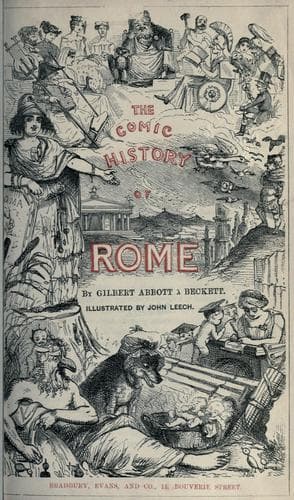
The Comic History of RomeÀ Beckett, Gilbert Abbott
History
The Comic History of Rome
À Beckett, Gilbert Abbott
Rome -- History -- Humor; Wit and humor, Pictorial
By way of narrowing the ground of dispute, he took his position in the
Pass of Thermopylæ, and had, for some time, maintained an advantage over
the Romans, when M. Porcius Cato, ascending the heights, ran round to
the rear, and, by a decisive blow on the enemy's back, changed the whole
face of the engagement. Antiochus fled in dismay, and never stopped to
look behind him, until he reached Asia Minor, when he sat down, and took
a gloomy retrospect of all that had happened. While he met with reverses
on land, he heard of the reverse, or rather the same thing, that had
happened to his fleet at sea; and he fairly gave up, not only his cause,
but the Chersonesus, Lysimachia, Sestos, and Abydos, with all their
contents and non-contents; the latter of which included the inhabitants.
Antiochus, though subdued in spirit, was not quite beaten in form; and a
large army was sent to Asia, under the command of the two consuls, L.
Cornelius Scipio and C. Lælius. L. C. Scipio, though without any
acknowledged merit of his own, had the good fortune to be the brother of
the celebrated Scipio Africanus, who got him the place; but it is
manifest that such an illegitimate step to an appointment will often end
in a grievous disappointment of one kind or another. To provide against
the ill consequences of this flagrant job, the celebrated Scipio went
out in the capacity of legate, to counteract the consequences of his
brother's general incapacity in the capacity of general. The Romans had
20,000 men, who, having arrived in Asia, met 70,000 soldiers of
Antiochus, at Magnesia, where the latter received a dose from which they
never recovered. Peace was granted to them on very humiliating terms;
but, however bitter the cup prescribed for Antiochus, so disagreeable
was the recollection of Magnesia, that he was obliged to swallow almost
anything that came after it.
Rome continued her system of giving independence to various places and
people, many of whom seemed so little to appreciate the proffered boon,
that in some cases money was tendered and accepted as the price of
exemption from the proposed advantages. The Cappadocians were so alarmed
at the prospect of their new freedom, that, being still free to confess
their dislike to it, they sent 200 talents to the Romans, who, no doubt,
mentally impressed with the proverbial baseness of the "slave who pays,"
quietly pocketed the money.
Public-domain text, read in full here on John Shaqi.
Reviews
Reviews
No reviews yet
Be the first to share your thoughts on this work.
Elsewhere in the archive
Join the Discussion
Join the discussion
Sign in to leave a comment or review.
Sign InorCreate an account