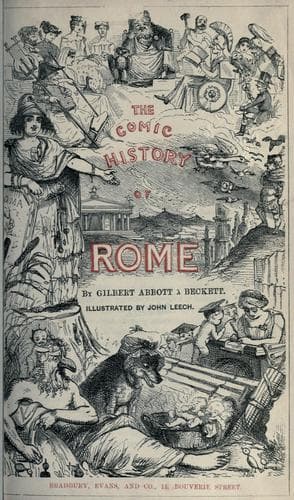
The Comic History of RomeÀ Beckett, Gilbert Abbott
History
The Comic History of Rome
À Beckett, Gilbert Abbott
Rome -- History -- Humor; Wit and humor, Pictorial
Hannibal had certainly, in his lifetime, shown proofs of greatness,
though, in the manner of his death, he gave evidence of lamentable
littleness. On the admirable principle of "look to the end," we are
unable to agree with those classical enthusiasts who regard Hannibal as
one of the most illustrious of mankind, because he was more daring and
more skilful in the art of exterminating his fellow-creatures than many
of his competitors. His personal ambition brought misery on his own, as
well as other countries, and his obstinate hatred to Rome was not
justified by his juvenile oath, for the taking of which he deserved
rather the birch than the laurel. The first public act of his life was
to swear when he was too young to have known what he was about, and the
last act was to poison himself at the age of sixty-two, when he was
quite old enough to have known better. He made a bad beginning, but a
worse ending, and he proved that, though aspiring to rule over others,
he was unable to command himself, and was in nearly every respect a
melancholy specimen of ill-regulated humanity.
Within about a year of Hannibal's death, Scipio Africanus also died in
exile. This great man, as it has been customary to call him, because he
was a large destroyer of the human race, was taken up before the Senate
on a charge of embezzlement. The case happened to be appointed for
hearing on the anniversary of some battle he had won, when he declared
the day was ill-suited for litigation, and the people, who are always
ready for an excuse for a holiday, immediately agreed with him. His
brother Lucius was involved in the same accusation, which he met by
producing his accounts; but, the popular idol seizing the books,
declared it was shabby for a nation to be too particular with those who
had served it so well, and tore up the whole of the financial statement.
Lucius Scipio remained in Rome; but Africanus ran away to a villa in
Campania, leaving his brother to undergo the confiscation of the whole
of his property. The innocence of Lucius was subsequently established,
and, though no "money returned," is generally the motto of the law, he
succeeded in getting back a part of what he had been unjustly deprived
of. He, however, having lived without his income, had no sooner got the
means restored to him of living within it, than he died, with the
melancholy satisfaction of having had justice done when it was too late
to be of the smallest earthly use to him.
Public-domain text, read in full here on John Shaqi.
Reviews
Reviews
No reviews yet
Be the first to share your thoughts on this work.
Elsewhere in the archive
Join the Discussion
Join the discussion
Sign in to leave a comment or review.
Sign InorCreate an account