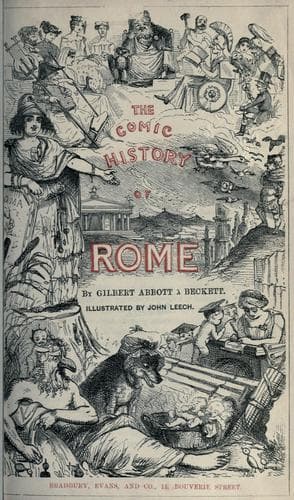
The Comic History of RomeÀ Beckett, Gilbert Abbott
History
The Comic History of Rome
À Beckett, Gilbert Abbott
Rome -- History -- Humor; Wit and humor, Pictorial
He continued to travel from place to place, and had spent the contents
of nearly all his statues, except a small one, so that his means had
literally come down to the lowest figure. In this dilemma he found
himself at Bithynia, where Prusias gave him house-room for a short time;
taking advantage of the visit, to render his guest useful in a war that
was being carried on against Eumenes, king of Pergamus. Hannibal,
however, could not persuade the parsimonious Prusias to go to the
expense of conducting hostilities in an effective style; and, indeed,
there being no money to carry on the war, it was impossible to do so
with credit; for nobody would make any advance on the security of a bad
sovereign. The Romans regarding Hannibal as a dangerous agitator, which
he had indeed proved himself to be, required that he should be given up;
but Prusias, declining to be at the expense of carriage, intimated that
whoever wanted Hannibal had better come for him. The Carthaginian
general, foreseeing his fate, endeavoured to make his escape by one of
seven secret passages leading from his house; but his enemies had found
them out, and were therefore certain of finding him at home; for they
had taken care to bar his egress.
[Illustration: Hannibal makes the usual neat and appropriate Speech
previous to killing himself.]
Though possessing all the courage of a soldier, he was miserably
destitute of a superior kind of fortitude, and he always carried a
bottle of poison about with him. Finding escape impossible, he drew the
fatal phial from his pocket, and, as he shook it up, he indulged in one
of those speeches which are usually attributed by classical historians
to men on the point of suicide. "I will," he said--or is said to have
said, for nobody could have heard him, as he was quite alone, and nobody
could have been listening, or the bottle would have been snatched out of
his hand; "I will deliver the Romans from the dread which has so long
tormented them, since they think it too long to wait for the decease of
a worn-out old man." Here he may be supposed to have paused; and, after
giving the bottle another final shake, to have continued as follows:
"Flaminius's victory over a foe, unarmed and betrayed, will not redound
much to his honour;" and, with a mental once, twice, thrice, and away,
the wretched Hannibal may be imagined to have raised the nauseous
draught to his lips, and to have tossed it off with desperate energy.
Public-domain text, read in full here on John Shaqi.
Reviews
Reviews
No reviews yet
Be the first to share your thoughts on this work.
Elsewhere in the archive
Join the Discussion
Join the discussion
Sign in to leave a comment or review.
Sign InorCreate an account