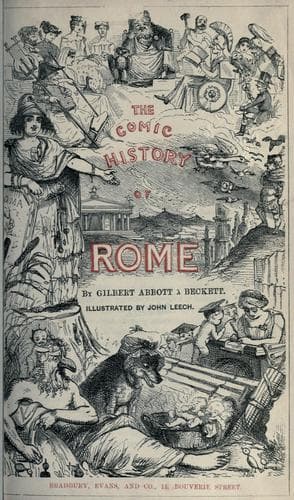
The Comic History of RomeÀ Beckett, Gilbert Abbott
History
The Comic History of Rome
À Beckett, Gilbert Abbott
Rome -- History -- Humor; Wit and humor, Pictorial
The state of war in which Rome habitually lived, had encouraged the
worst passions of the people; and nearly every vice had taken an iron
hold of them. By continually fighting, they had become familiar with
murder and violence, while the practice of plunder had accustomed them
to robbery. Military stratagem--which was the very essence of
strategy--had taught them to regard cunning as a virtue; and he was a
hero, in their opinion, who would face the swords and spears of a foe,
but sought in poison a cowardly refuge from the "slings and arrows" of
his own conscience. The wealth taken by force was often appropriated by
fraud; and a successful leader thought nothing of putting into his own
pocket an enormous sum, declaring that it was unreasonable to expect a
general to be particular.[56] The few became enormously rich, while the
many were miserably poor. The higher orders grasped everything, leaving
nothing to those beneath, and the consequence was a state of
top-heaviness, which, when existing in the social column, exposes base
and capital--but especially the latter--to extreme danger. Money had
been acquired by some, who did not know its use; and its abuse was the
inevitable result; for the improper employment of gold leads to every
kind of guilt on the part of those who are possessed of it.
With the wealth of other nations, foreign fashions were imported, and
Roman simplicity was superseded by the art and cunning of the Grecian
craftsmen. The pleasures of the table were carried to a gluttonous
excess; and a slave who, in the capacity of a cook, could set before his
master an agreeable kind of sauce, was often allowed impunity for
insolence.
Extravagance began to prevail to such an extent among the Roman women,
that those females whose wardrobe was of a gaudy hue, were virtually
condemned to dye, for a law was passed by the tribune Appius,
prohibiting them from wearing dresses of a gay colour. The same law
limited them to half-an-ounce of gold; but this was unnecessary; for the
extravagantly-disposed would spend all they had; and they were further
restricted from riding at or near Rome, or any other city, in a carriage
drawn by two horses; for it was considered that with one the road to
ruin could be quite rapidly enough travelled. This law occasioned some
violent agitation among the Roman women, who manifested the force of
female influence so effectually, that in a few years the law was
repealed.
[Illustration: Roman Lady "Shopping."]
Public-domain text, read in full here on John Shaqi.
Reviews
Reviews
No reviews yet
Be the first to share your thoughts on this work.
Elsewhere in the archive
Join the Discussion
Join the discussion
Sign in to leave a comment or review.
Sign InorCreate an account