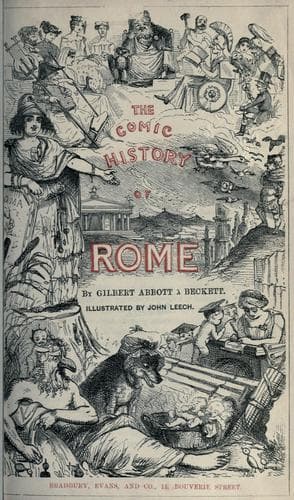
The Comic History of RomeÀ Beckett, Gilbert Abbott
History
The Comic History of Rome
À Beckett, Gilbert Abbott
Rome -- History -- Humor; Wit and humor, Pictorial
The stern necessities of historical truth compel us to attribute to what
is termed the gentler sex, the introduction, among the Romans, of some
vices so foul, as to be at variance with all our notions of the fair.
One of the worst of these enormities was the celebration of the
Bacchanalia, introduced from Etruria; and recent discoveries[57] in that
locality have initiated us into the secret of what are usually termed
the Bacchic mysteries. The mystification of the votaries was
accomplished by drink; under the influence of which they wound up their
festivities with a reel, such as may be traced in ancient paintings; and
round every such reel there is twined some important thread of history.
Imitation is seldom respectable in any case; for even merit loses half
its value when it is not original; but nothing can be more contemptible
than a people putting on bad habits at second-hand. Such, however, was
the practice of the Romans, who borrowed nearly all their iniquities
from Athens or other cities, and who wilfully brought upon themselves
the moral stain of Greece. Cruelty, which goes hand in hand with
depravity, had reached such an infamous excess, that it was practised
openly by those whom the people delighted to honour. Among other
instances, may be cited the example of the Consul L. Quinctius
Flaminius, who, while encamped in Gaul, happened to be feasting with one
of his degraded creatures, when the latter lamented he had never seen a
gladiator killed. A noble Boian entering at the moment, to ask for
shelter, Flaminius observed that, though unable to treat his friend to
the sight of a dying gladiator, he might satisfy his appetite for
cruelty by the exhibition of a dying Gaul. The "creature" had no sooner
expressed his readiness to accept the lighter relish as a substitute for
the more substantial meal, than Flaminius, drawing his sword, smote the
unfortunate Boian on the head, and ran him through the body. So
brutalised had the people become by continual war, that no notice was
taken of this occurrence until eight years afterwards, when Cato, the
Censor, brought up the charge, with a variety of others, more or less
weighty, against Flaminius, and caused his expulsion from the Senate.
The name of Cato the Censor, naturally induces a few observations on the
character of this ancient specimen of the
"Fine old Roman gentleman all of the olden time."
Public-domain text, read in full here on John Shaqi.
Reviews
Reviews
No reviews yet
Be the first to share your thoughts on this work.
Elsewhere in the archive
Join the Discussion
Join the discussion
Sign in to leave a comment or review.
Sign InorCreate an account