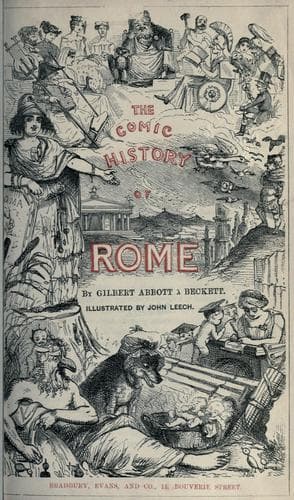
The Comic History of RomeÀ Beckett, Gilbert Abbott
History
The Comic History of Rome
À Beckett, Gilbert Abbott
Rome -- History -- Humor; Wit and humor, Pictorial
The mantle of Plautus--supposing the dramatist to have died with a coat
to his back--may be said to have fallen on Terentius Afer, or Terence.
He is believed to have been born at Carthage, and to have been the slave
of a Roman senator; for his biographers--who, by the way, were writers
themselves--will not hazard the supposition that one of their own order
could have been the son of a gentleman. Terentius, however, got into
what is usually termed the best society, which had the usual effect of
the "best society" on a literary man; for it took what it could never
compensate him for--his time; it led him into idle and extravagant
habits, and thus brought him, where it will inevitably leave him, if it
once gets him there--to ruin. His fashionable friends carried their
patronage so far, as to tax his reputation as well as his means, and
even claimed a share in the credit of his writings, declaring the best
part of them to be their own, though they suffered Terentius to affix
his name to them.
Scipio Africanus, who stands convicted of fraud and embezzlement in a
former chapter,[60] had the effrontery to say, or allow it to be said,
that he had written portions of the plays in question, or, at least,
contributed some of the jokes; but we have nothing to support the claim,
except the fact that he might, perhaps, have made a pun, as he is known
to have picked the public pocket. The following anecdote, related by his
biographer, Donatus, or Suetonius--for the learned are at issue, and
have long been stumbling over the two styles--may afford some idea of
the treatment to which authors were submitted in the age we are writing
of. Having completed his play of "Andria," Terence was desirous of
getting it licensed, and applied to the Ædiles, who referred him to
Cæcilius, for an opinion on the manuscript. The critic being at dinner,
desired the dramatist to take a seat on a low stool, and read his piece,
so that Cæcilius might, at the same time, swallow his meal, and digest
the new comedy. Terence had read but a few verses, when the critic
declared he could not continue selfishly putting good things into his
own mouth, while so many good things were coming from the mouth of his
visitor. He was requested to put the comedy away until after the dinner,
which he was invited to share; and, having done so, the play was
finished over a glass or two of wine, which increased the enthusiasm
with which the author read, and the critic listened. Both were delighted
with each other. Their better acquaintance was drunk; success to the
comedy was drunk; their healths were drunk together; and, ultimately,
Cæcilius and Terence were drunk separately as well as jointly, before
the termination of the evening.
Public-domain text, read in full here on John Shaqi.
Reviews
Reviews
No reviews yet
Be the first to share your thoughts on this work.
Elsewhere in the archive
Join the Discussion
Join the discussion
Sign in to leave a comment or review.
Sign InorCreate an account