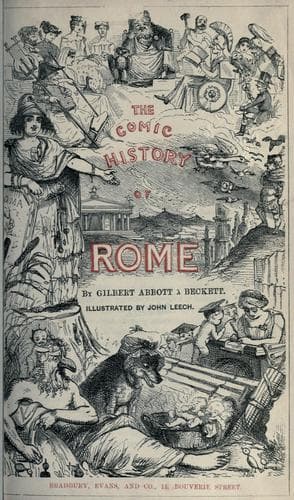
The Comic History of RomeÀ Beckett, Gilbert Abbott
History
The Comic History of Rome
À Beckett, Gilbert Abbott
Rome -- History -- Humor; Wit and humor, Pictorial
The earliest Roman dramatist is supposed to have been one Lucius
Andronicus, who had formerly been a slave, and who continued his slavish
propensities by a servile adaptation of Greek plays, instead of boldly
attempting an original production. Like many of the modern translators,
he was himself an actor in his own pieces; and it is declared by Livy
the historian, that he lost his voice by the frequency with which he was
encored by the audience. This statement seems to show that puffs were
not unknown when the Roman drama was in its very earliest stage; for the
assertion in question could scarcely have been true, since Cicero[59]
has told us that there was nothing worthy of being read or listened to
twice, in the plays of Lucius Andronicus.
The greatest comic writer of the period at which our history has
arrived, was Marcus Accius Plautus, of whose origin little is known; for
the Romans held their wits and humorists in such little respect, that as
long as they could raise a laugh, it mattered little who they were,
whence they sprung, or what became of them. It was not until after a
writer's death that any interest was felt in his life, and such was the
case with regard to Plautus, who has been the subject of more invention
than is to be found in all his comedies. Conjecture--the author of half
the history, and three-fourths of the biography, which the world
possesses--describes Plautus as a low-born fellow, made of the very
commonest clay, moulded by one of Nature's awkwardest journeymen into a
misshapen lump, and whose angular deformities constituted his chief
points of humour. Having made a little money as a dramatist, he is said
to have embarked it in the baking business; some would say that he might
make his own puffs; but his shop failed, and as the public would not, he
of course could not, get his bread at it. He next entered the service of
a miller and master baker, where he attempted, in grinding corn, to turn
at once the handle of a mill and an honest penny. Even in the bakehouse
he was unable to forget the flowery path of literature; and while
watching the bread, he managed to inscribe on different rolls no less
than three comedies. Of these he made sufficient to enable him to quit
the oven, which was incapable of warming his imagination; and taking
lodgings in Rome, he resumed the life of a dramatist.
What Plautus may have wanted in originality, he made up for by
industry, there being still extant twenty of his plays, and he was,
according to some, the author of one hundred pieces.
Public-domain text, read in full here on John Shaqi.
Reviews
Reviews
No reviews yet
Be the first to share your thoughts on this work.
Elsewhere in the archive
Join the Discussion
Join the discussion
Sign in to leave a comment or review.
Sign InorCreate an account