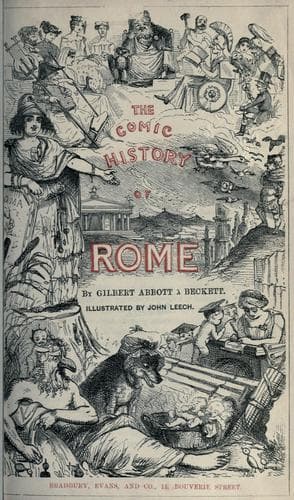
The Comic History of RomeÀ Beckett, Gilbert Abbott
History
The Comic History of Rome
À Beckett, Gilbert Abbott
Rome -- History -- Humor; Wit and humor, Pictorial
His prospects of ulterior measures were, however, sufficiently remote to
induce him to attempt an arrangement through the intervention of his son
Demetrius. The latter had been educated in Rome, and of course had a
thorough understanding of the Roman character. He succeeded in his
mission, but he obtained his end in a less agreeable sense; for his
existence was brought to a close by treachery. Some designing persons
fomented a feeling of jealousy between himself and his elder brother,
Perseus, who poisoned the mind of Philip with such fatal effect, that he
caused the poisoning--not merely mental, but physical--of his son
Demetrius. When the wretched parent discovered that he had been duped,
he became so uneasy in his mind, that he went quite out of it, and died
at the age of three-score, unable to meet the heavy score that he had
run up against himself in the court of his own conscience.
Perseus was hailed by the Romans as king; but all their hailing could
not render his reign prosperous. He endeavoured to cement his power by a
marriage with the daughter of Antiochus Epiphanes, for Perseus thought
that the aid he would derive from the match, would render him more than
a match for his enemies. He gave his sister to Prusias of Bithynia, in
the hope that the latter, having married into the family, would feel
himself wedded to its interests. Avarice was, however, the ruin of
Perseus; for he did not understand the true use of the purse, which he
used his utmost exertions to fill, and then held its strings with
parsimonious stringency. He had promised to pay his allies, but their
zeal in his cause subsided when they were left without their subsidies.
Eumenes of Pergamus being among others seized with a panic, went to Rome
to ask advice, and on his return nearly lost his life on the highway, by
some persons who attacked him in a very low manner. He was passing a
narrow footpath near Delphi--from which it would appear that he had
walked at least a portion of the way--when some persons concealed in the
rocks, hurled down several large blocks of granite, which though not
causing his death, brought him within a stone's throw of it. Several
huge pieces having fallen upon him, something struck him that all was
not right; and he was revolving the affair in his mind, when he found
himself rolling down the precipice. He was picked up nearly lifeless,
but though very much jammed, he was preserved; and though almost dashed
to pieces, he was sufficiently collected, in a few days, to be enabled
to go home, by another road, to Asia. It was said that Perseus had had a
hand in this disgraceful affair; but he declared that even if he had
wished for the death of Eumenes, he would not have been guilty of making
such a desperate push for it.
Public-domain text, read in full here on John Shaqi.
Reviews
Reviews
No reviews yet
Be the first to share your thoughts on this work.
Elsewhere in the archive
Join the Discussion
Join the discussion
Sign in to leave a comment or review.
Sign InorCreate an account