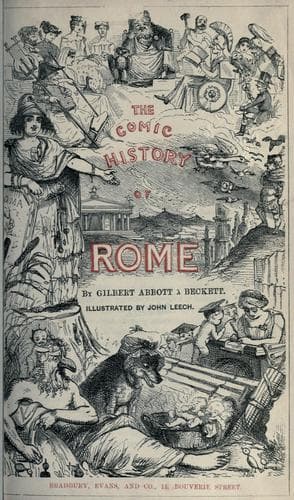
The Comic History of RomeÀ Beckett, Gilbert Abbott
History
The Comic History of Rome
À Beckett, Gilbert Abbott
Rome -- History -- Humor; Wit and humor, Pictorial
Robbery had greatly augmented the public wealth; but individuals were
wretchedly poor, with the exception of the few who had had a hand in the
pockets of the conquered nations. Slaves were brought in such numbers to
Rome, that at length they would hardly fetch a price; and so many were
brought from Sardinia, who were constantly being put up, knocked down at
nothing, bought in, and left on hand, that "Sardians to sell!" passed
into a proverb to express an unsaleable article. In vain were the poor
creatures prepared to do as they were bid, for no one would give them a
bidding. The Greek captives fetched a higher price, for they were many
of them accomplished men, and became tutors, music-masters, or teachers
of painting, in the families of their purchasers. Among the hostages
brought to Rome, was Polybius the historian, who got so good a living by
giving lessons, that though he had been brought to Rome against his
will, he solicited the privilege of remaining there. His "Universal
History," in forty books, was a work that ought to be, and would have
been, in every gentleman's library, but for the unfortunate fact of its
having been nearly all lost: and we may judge of the excellence of the
whole, from the knowledge that though what remains of the work is very
good, by far the best part of it is missing.
FOOTNOTES:
[56] P. Cornelius Scipio gave no better answer than this to a charge of
having embezzled a sum amounting to 36,000_l._ sterling.
[57] _Vide_ "The Cities and Cemeteries of Etruria," by Dennis.
[58] De Re rustica.
[59] Brut., c. 18
[60] Chapter xix., p. 202.
[61] Diomedes, iii., p. 486, ed. Putsch.
CHAPTER THE TWENTY-FIRST.
WARS AGAINST PERSEUS. THE THIRD PUNIC WAR. SIEGE AND DESTRUCTION OF
CARTHAGE, AND DITTO DITTO OF CORINTH.
Philip of Macedon bad been from time to time waging war with Rome; but
the wages of the troops were so exhausting to his means, that he was
driven to a hollow peace by his empty pockets. He had agreed to confine
his dominion within a certain space; but, as his ambition had no bounds,
he would not be content that his territory should have any limits. He
accordingly fought with and thrashed the Thracians, who sent ambassadors
to Rome for the purpose of showing him up, as it were, to their common
master. Rome punished him by ordering him to keep within bounds; and
threatened, that if he should be found venturing out of bounds, he
should be severely punished. Philip muttered something about seeking
justice elsewhere--a threat of paulo-post-future revenge which is common
with those who, being engaged in a dispute, have got decidedly the worst
of it.
Public-domain text, read in full here on John Shaqi.
Reviews
Reviews
No reviews yet
Be the first to share your thoughts on this work.
Elsewhere in the archive
Join the Discussion
Join the discussion
Sign in to leave a comment or review.
Sign InorCreate an account