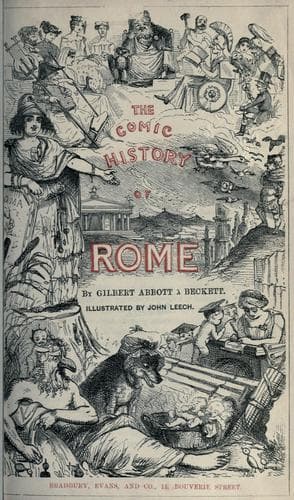
The Comic History of RomeÀ Beckett, Gilbert Abbott
History
The Comic History of Rome
À Beckett, Gilbert Abbott
Rome -- History -- Humor; Wit and humor, Pictorial
After flying from place to place, like a hunted hare, he felt the game
was up, and, retreating to Samothrace, he consigned his weary head to
the shelter of Castor, in whose temple he hid himself. He had managed to
carry about with him a large supply of treasure, which he was anxious to
save, and had hired a mariner to take him to Crete; but the money having
been first sent on board, the crafty seaman, out of curiosity, weighed
the gold, and immediately weighed anchor. Perseus having gone down to
the beach, to embark, saw the ship in the offing, and, having watched
it, he perceived that it was fairly, or rather unfairly off, with all
his treasure. As he paced the shore, he felt himself quite aground, and,
having no lodging for the night, or the means of obtaining one, he
returned to the solitary chambers of the temple. Having a wife and
family to provide for, he threw himself on the generosity of Æmilius,
who gave him a subsistence, but loaded him with chains, that he might
feel the weight of his obligations. The unhappy Perseus was made to walk
in a triumph before the car of his conqueror; and though he had
entreated that he might not be so lowered, he was still further let
down, by cruel confinement in a subterranean dungeon. His
fellow-prisoners are said to have offered him a sword, to end his days,
but, on looking at the weapon, he very properly declined to bring his
sufferings to a point, by an act of folly and wickedness. He eventually
found his way to Alba, where he died in about two years; his son,
Alexander, having adopted the trade of a turner, with the laudable view
of turning an honest penny.
Paulus Æmilius exercised the usual privilege of a conqueror, by robbing
the vanquished of all they had possessed; and Macedonia was declared
free, in the customary manner, by placing it entirely under the
government of its foreign victors.
The triumph of Paulus Æmilius was one of the most magnificent shows that
had ever been seen, and lasted three days, during which a perpetual fair
was kept up; for, among the Romans, "None but the brave deserve the
fair" was a maxim literally followed. On the first day there was a
procession of pictures, showing the exploits of Æmilius in the brightest
colours. The second day was devoted to the carrying of the trophies and
the silver coin; but, on the third, which was the grandest day of all,
the gold was paraded, followed by 120 bulls, which seem to be suggestive
of nothing belonging to war but its butchery. After these came the
unhappy Perseus, loaded with fetters, and having about him some other
links of a far more affecting kind, in the shape of his three children.
Public-domain text, read in full here on John Shaqi.
Reviews
Reviews
No reviews yet
Be the first to share your thoughts on this work.
Elsewhere in the archive
Join the Discussion
Join the discussion
Sign in to leave a comment or review.
Sign InorCreate an account