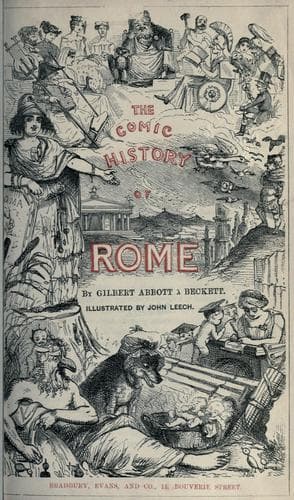
The Comic History of RomeÀ Beckett, Gilbert Abbott
History
The Comic History of Rome
À Beckett, Gilbert Abbott
Rome -- History -- Humor; Wit and humor, Pictorial
The fame spread by the fate of Perseus was general among the kings of
the earth, who flocked like sheep, or rather, crawled like curs, to do
homage to the Roman Senate. Perseus arrived with his head shaved, as if
to show that he owed not only his crown, but his hair and all, to Rome;
and he wore the tattered garments of a freed slave, as if to prove that
he had not a rag to his back, but what he held at the pleasure of his
masters.
All who had shown any sympathy with the cause of Perseus were cruelly
persecuted, and the unfortunate Rhodians were so terrified with the bare
anticipation of their fate, that they began to anticipate it in reality,
by making away with themselves and with one another. On the few who
remained the hardest conditions were imposed, which made their own
condition the more deplorable. Carthage and the Achaian League were the
only two powers that seemed to stand in the way of Rome, and of these
the latter was thought so contemptible, that some Achaians who had been
detained in Italy were saved by a sarcasm of Cato on their feebleness
and decrepitude. "We have only to decide," said he, "whether these poor
creatures shall be buried by their own grave-diggers, or by ours;" a
cruel pleasantry, which, however, had a humane result, for it was
decided that they should be at liberty to go home and yield to their
native undertakers the profit--or loss--attendant on their funerals.
The Carthaginians had been for some years at peace with Rome, but had
been much harassed by some of her allies, and particularly by
Massinissa, their neighbour, in Numidia. It was annoying enough to be
subjected to attack, but it was still more provoking to be unable to
return the blow, which was the case with Carthage, whose hands were tied
by a bond prohibiting her from going to war without Rome's permission.
An appeal was addressed to Rome, which sent ambassadors, who were
instructed to hear the Carthaginians, but to decide in favour of
Massinissa. Carthage at length grew tired of allowing Rome to hold the
scales of justice; for, though the scales might have been true, a false
weight was always attached to one side, which gave it a vast
preponderance.
Public-domain text, read in full here on John Shaqi.
Reviews
Reviews
No reviews yet
Be the first to share your thoughts on this work.
Elsewhere in the archive
Join the Discussion
Join the discussion
Sign in to leave a comment or review.
Sign InorCreate an account