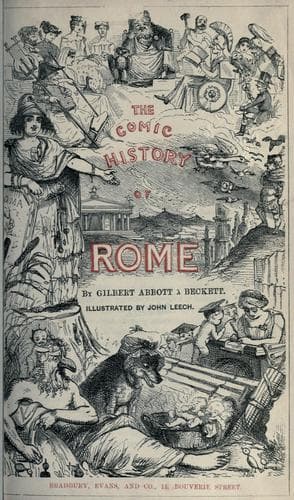
The Comic History of RomeÀ Beckett, Gilbert Abbott
History
The Comic History of Rome
À Beckett, Gilbert Abbott
Rome -- History -- Humor; Wit and humor, Pictorial
Mummius, thinking it idle to pursue the fugitive, preferred following up
his advantage, and arrived at the gates of Corinth, which had been left
wide open by the citizens. The place was deserted; and Mummius not only
sacked its palaces, but ransacked its private houses, and, looking into
its magazines, extracted from them some very valuable articles. So
little, however, did he understand or appreciate art, that when sending
valuable pictures or pieces of sculpture to Rome, he told the sailors,
that if any damage was done on the voyage, he would make them execute
objects precisely similar to those with which he entrusted them. Among
the pictures was the celebrated "Bacchus" of Aristides,--which was so
perfect as to be looked upon as one of the wonders of the world--and,
when consigning it as part of a cargo of curiosities, he declared that,
if any injury was done to it, the ship's painter should immediately
paint another. Such was the barbarism of the destroyers of Corinth, that
this picture was only rescued by Polybius from the hands of the
soldiers, who were gambling on its face, and who, with every throw of
the die, took off a portion of its colour.
The scenes enacted during the pillage of Corinth were barbarous in the
extreme, and involved the total destruction of what may have been termed
one of the chief pillars of civilisation--or, at all events, its
Corinthian capital. Many of the Roman soldiers, intoxicated with success
and something more, perished in the flames, to which the city was doomed
by the barbarous order of Mummius. When the conflagration first
commenced, it is said that a liquid metal was seen to flow through the
streets, which induced the invaders to rush forward in the hope of
profiting by such a strange metallic currency. Those, however, who laid
their hands upon the tempting issue, as it ran from the banks on either
side of the thoroughfare, found it a mass of floating fire, with which
they terribly burned their fingers. On cooler examination the material
proved to be a fusion of beautiful ores, to which the name of Corinthian
brass has since been given.
[Illustration: Bacchanalian Group, from a very old Vase.]
Public-domain text, read in full here on John Shaqi.
Reviews
Reviews
No reviews yet
Be the first to share your thoughts on this work.
Elsewhere in the archive
Join the Discussion
Join the discussion
Sign in to leave a comment or review.
Sign InorCreate an account