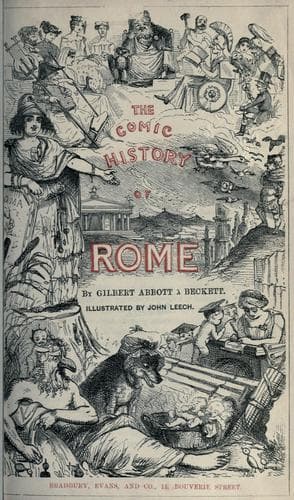
The Comic History of RomeÀ Beckett, Gilbert Abbott
History
The Comic History of Rome
À Beckett, Gilbert Abbott
Rome -- History -- Humor; Wit and humor, Pictorial
Of the three pretenders just alluded to, the only one who had been able
to maintain his ground--though, by the way, the ground was never his to
maintain--was a young man, who declared himself to be Philip, the son of
Perseus. The youth was certainly very like his alleged father; and, upon
the strength of the resemblance in features, he put upon his claim such
a bold face, that the Macedonians favoured it. They put their crown upon
his head, and the kingly name seemed to have invested the young
adventurer with a tower of strength; for he was successful in an attack
upon the Romans, under the consul Juventius. The impostor, however, soon
lost control over himself, and there was at once an end to his influence
over his new subjects. They threw him off, and he was compelled to take
refuge in a Court inhabited by one Bysas, a petty Thracian prince, who
gave up, or, more probably, sold, the fugitive, who had sought his
hospitality. The pretender, who had led away so many others, was
eventually led away himself, and made to march as a "frightful example"
in the triumph of Metellus.
About this time the Achaians, who had entered into a league, began to
quarrel among themselves; for Sparta, like a spoiled child, wanted to
have its own way, and sulked, as it were, alone in a corner, apart from
the rest of the confederacy. Rome was appealed to for advice, and Roman
ambassadors came to Corinth; but they were so unpopular, that on a visit
to the theatre, where they had gone, expecting fair play, they were
insulted and pelted by the audience. This irritated the Romans, and an
army was sent, under Mummius, to encounter the Greek general Diæus, who
made so certain of victory, that he had seats erected for the women and
children to see him win a battle. He had prepared everything in the
neighbourhood of Corinth, and appropriating the privilege of the brave
who are said to deserve the fair, he clustered a large bevy of female
beauty round the spot of his intended achievement. The ladies were all
expectation, and Diæus was all confidence, until Mummius made his
appearance, and in a very few minutes sent Diæus flying towards
Megalopolis. Here he entered his own abode, and setting fire to the
premises, celebrated, with the most dismal of house-warmings, the defeat
that took the place of his intended victory.
Public-domain text, read in full here on John Shaqi.
Reviews
Reviews
No reviews yet
Be the first to share your thoughts on this work.
Elsewhere in the archive
Join the Discussion
Join the discussion
Sign in to leave a comment or review.
Sign InorCreate an account