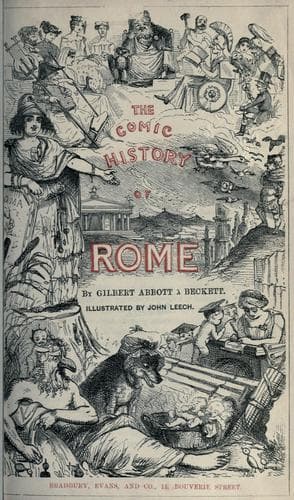
The Comic History of RomeÀ Beckett, Gilbert Abbott
History
The Comic History of Rome
À Beckett, Gilbert Abbott
Rome -- History -- Humor; Wit and humor, Pictorial
War had become so familiar to the Romans, that they never felt at home
unless they were fighting abroad, and the sword was the only thing they
took in hand with real earnestness. The intoxication of success, like
other habits of intoxication, cannot be easily got rid of, and the
Romans sought to indulge their thirst for conquest in a manner wholly at
variance with sober judgment. Their design was to conquer Spain, and in
the execution of this design they cruelly executed large numbers of the
Lusitanians, who had laid down their arms, in consequence of a promise
that if they quitted the field of battle, they should be allowed quiet
possession of the fields of peaceful industry. On this assurance, they
divided themselves into three parts, and were then--as we are gravely
assured by the chroniclers--treacherously cut into several thousand
pieces. One of the few that escaped was Viriathus, who combined the
qualities of the wolf and the lamb, for he had turned a desperate
robber, after having been employed as a gentle shepherd. Abandoning the
honest hook of a pastoral life, he had adopted the more crooked ways of
the common thief; and he seems to have gradually stolen upon the
confidence of his countrymen, until they made him a general. He had
passed his early days among the mountains, and was prepared for the ups
and downs of life, which he afterwards experienced. His predatory
properties had taught him how to attack, and his practice as a
robber--which rendered it necessary for him frequently to keep out of
the way--had familiarised him with the art of avoiding an enemy. He
would appear suddenly from the thick of a thicket, and after doing
considerable mischief, he would find concealment in the hollow of some
rock which his companions would never split upon. Though he had
commenced his career as a poor country clown, he had trained himself to
perform feats of activity worthy of the most experienced Harlequin.
Life, which is a drama in the case of most men, was, in his case, a
series of scenes in a pantomime. He was here, there, and everywhere,
when he was not expected, and he was immediately nowhere when his
opponents were in pursuit of him. His policy was first to scatter, and
then to destroy; to divide an enemy _en gros_, and cut it to pieces _en
detail_. He had encountered Vitellius, the Roman Prætor, near a place
called Tribula, where the latter got into the utmost tribulation by
being led through briers and bushes into an ambush, where he lost half
his army. The other half lost him, for he was killed by the sword of
some one who did not know him, though, had he been known, the
acquaintance would, most probably, have been cut in the same barbarous
manner.
[Illustration: Assassination of Viriathus.]
Public-domain text, read in full here on John Shaqi.
Reviews
Reviews
No reviews yet
Be the first to share your thoughts on this work.
Elsewhere in the archive
Join the Discussion
Join the discussion
Sign in to leave a comment or review.
Sign InorCreate an account