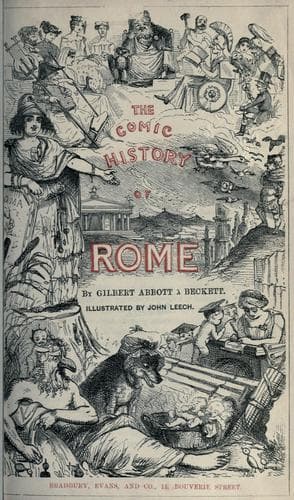
The Comic History of RomeÀ Beckett, Gilbert Abbott
History
The Comic History of Rome
À Beckett, Gilbert Abbott
Rome -- History -- Humor; Wit and humor, Pictorial
Viriathus for some time baffled the enemy by cunning and address, or
rather by having no address at all, for he had no fixed residence; and
there was, consequently, much difficulty in finding him. At length he
fought a battle, in which he was so far successful that a peace was
concluded, in which he was acknowledged as the friend and ally of Rome;
but having no one to save him from his friends, he was basely murdered
in his sleep by some Lusitanian assassins that the Roman general had
hired. The instigators of this barbarous act refused to pay when the
sanguinary work was done; and the murderers, in making a demand on
account of their crime, may be said to have, figuratively, cut their own
throats, for they were threatened with punishment for the iniquity they
confessed themselves guilty of. After the death of Viriathus, the
Lusitanians having lost their head, were without the brains necessary to
defend themselves, and fell an easy prey into the hands of Q. Pompeius.
This individual was the son of a musician; but instead of following his
father's profession, he had become the leader of a warlike band, and he
found the soldiers willing instruments to play into his hands, or act in
concert with him, for the gratification of his personal ambition. He
attacked Numantia, though with so little success, that he was compelled
to conclude a peace; but treacherously declaring that the conclusion of
a peace meant the beginning of a war, he renewed hostilities at the
first convenient opportunity. Subsequently, C. Hostilius Mancinus
commenced an attack, but 10,000 of his men having been killed, and
20,000 more being blocked up in a ravine, he could not exactly see his
way out of it without a surrender. The Numantines refused to treat with
him, until young Tib. Sempronius Gracchus, whom they trusted, came
forward to pledge his honour that Numantia should be fairly treated. The
Senate, however, repudiated the arrangement, and the honour of young
Tib. remains among the enormous stock of unredeemed pledges which
history has handed down to us.
The Romans began to feel that none but the best man was likely to win,
and they accordingly looked out for the best man, whom they found in
Scipio Africanus, the destroyer of Carthage. He was sent against
Numantia, which he surrounded by fortifications, in order that he might
starve out the inhabitants by keeping them in, and he did his utmost to
restore the discipline of the Roman army. He hardened the soldiers by
making them carry loads of wood, a novel plan of providing them with a
billet; he forced them to sleep on the ground, which they complained of
as hard; and he allowed them no other cooking utensils than a saucepan,
which caused the indignation of many to boil over.
Public-domain text, read in full here on John Shaqi.
Reviews
Reviews
No reviews yet
Be the first to share your thoughts on this work.
Elsewhere in the archive
Join the Discussion
Join the discussion
Sign in to leave a comment or review.
Sign InorCreate an account