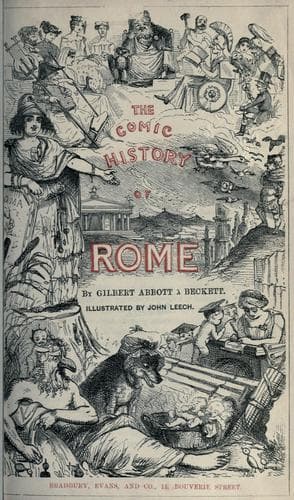
The Comic History of RomeÀ Beckett, Gilbert Abbott
History
The Comic History of Rome
À Beckett, Gilbert Abbott
Rome -- History -- Humor; Wit and humor, Pictorial
Numantia stood upon a lofty rock, and its inhabitants displayed a
courage worthy of its high position. The river Durius (now the Douro)
washed its feet; there were forests on either hand; while the mounds and
ditches abounding in the vale before it, rendered any attempt to
approach it in the front almost unavailable. Scipio Africanus soon
perceived the hopelessness of succeeding by a direct attack, and he
proceeded, therefore, to raise round the place a double stockade, to
prevent any aid in the form of a stock of provisions being carried into
it. He impeded the navigation of the river by throwing across it large
beams, perforated with swords, which, revolving with the tide, cut off
all communication by means of water.
Notwithstanding all the precautions that had been taken, a party of
about half-a-dozen young men, having slipped through the lines--and very
hard lines they were--succeeded in reaching the town of Lutia. The head
of the party, holding an olive-branch, begged for assistance with such
effect, that the Lutians offered to lend him a hand in his terrible
emergency. Scipio, who had been in pursuit, no sooner heard of the
Lutians having offered to lend a hand, than he savagely declared that
they should have no hands to spare, and he barbarously ordered the
cutting off of the hands of four hundred citizens.
The Numantines being completely hemmed in, were unable to obtain
provisions; but though reduced at last to eat cats, they became only the
more dogged in their resistance to the enemy. Eventually, they begged
for a truce of three days, which they employed in destroying their wives
and children--a species of heroism not easily understood; for to kill
those who are dear, by way of protecting them, is a mode of insurance of
which we must dispute the policy. The men were so sadly dispirited, and
so fearfully cut up by their own or each other's swords, that the
conquerors had only a remnant to take, in the shape of population, when
they entered the city.
In conformity with the custom of the period, Scipio Africanus Minor,
whose atrocities, in connexion with the siege of Numantia, have branded
his name for ever with disgrace, proceeded to make arrangements for a
triumph. Instead of feeling a decent shame, he manifested a most
unbecoming pride in what he had done; and to identify himself more
completely with the horrors of the siege, he took the name of
Numantinus. So thoroughly had starvation done its work, that of the few
citizens who were found alive, only fifty were in sufficiently good
condition to appear in the show got up in celebration of his
dishonourable victory.
Public-domain text, read in full here on John Shaqi.
Reviews
Reviews
No reviews yet
Be the first to share your thoughts on this work.
Elsewhere in the archive
Join the Discussion
Join the discussion
Sign in to leave a comment or review.
Sign InorCreate an account