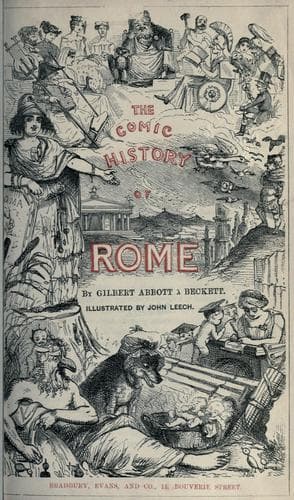
The Comic History of RomeÀ Beckett, Gilbert Abbott
History
The Comic History of Rome
À Beckett, Gilbert Abbott
Rome -- History -- Humor; Wit and humor, Pictorial
The demand for slave labour in Rome was caused by the annual consumption
of the free population in war, at whose bidding many who should have
remained to cultivate the land, were sent forth to plough the ocean. The
result was a redundancy of slave population, accustomed to agricultural
labour of every kind, and which, having been already brought under the
yoke, had become sufficiently brutalised to do the work of oxen. The
chief supply of slaves was drawn from the prisoners taken in war, and an
army was generally attended by dealers, who, in case of a glut, could
frequently buy a lot cheap; and at the camp of Lucullus they were being
picked up for about three shillings and three-pence of our money--or
four drachmas. In Rome it was usual to sell slaves by auction, and, as
if the poor wretches were not already low enough, they were knocked down
by the hammer. The dealers were in the habit of practising the same sort
of tricks to conceal the defects of a slave, as are, in these days,
employed to hide the faults of a horse, and it was customary therefore,
in purchasing, to require a warranty. The character was often suspended
on a scroll round the neck, and their chief recommendation consisted in
a guarantee that they would neither commit suicide, nor steal--having no
tendency to make away with either themselves or their master's property.
There was a considerable variation in the value of slaves, and fancy
prices have been known to be given for some curious specimens of captive
humanity. A fool has been known to fetch 20,000 sesterces--about one
hundred and seventy pounds--a sum that would seem to show that folly was
scarce; but when we remember how wise a man is required to make a fool,
we may take it for granted that the wisdom comprised in the subject of
the bargain was the rare and costly part of it. Literary men were often
exposed for sale like cattle when they happened to be slaves, and the
useful hack, or occasionally the literary lion, might be seen chained to
a pen in the public market-place. Slaves had no distinctive dress; and
when it was once proposed to give them one, the measure was rejected, on
the ground that it might show them their numerical strength, and that if
they once saw their power by obtaining their livery, they might attempt
to take up their freedom. It was deemed better to keep them in the dark,
by clothing them in sombre colours, and their numbers not being
manifested to them by any peculiar dress, it was not likely they would
unite in order to redress their grievances.
Public-domain text, read in full here on John Shaqi.
Reviews
Reviews
No reviews yet
Be the first to share your thoughts on this work.
Elsewhere in the archive
Join the Discussion
Join the discussion
Sign in to leave a comment or review.
Sign InorCreate an account