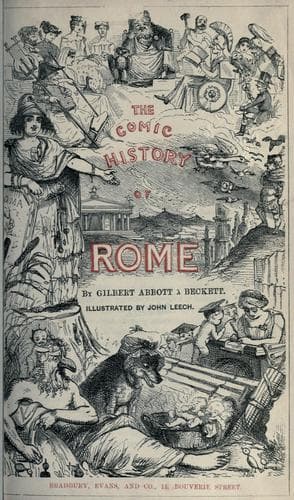
The Comic History of RomeÀ Beckett, Gilbert Abbott
History
The Comic History of Rome
À Beckett, Gilbert Abbott
Rome -- History -- Humor; Wit and humor, Pictorial
There is, however, something elastic in human nature, which causes it to
rise after being trodden on. Such was the case with the slaves, who
began to swell with indignation, which was rendered particularly tumid
by the inflated and inflating eloquence of one Eunus, a Syrian, who was
a member of their own body. This individual possessed the art of oratory
in a high degree, and there is nothing more stimulating to the breeze of
discontent than the breath of an enthusiastic demagogue. He persuaded
the slaves to revolt, and while preaching to them the doctrine of
equality, he claimed to be not only their leader, but their prince and
ruler--a species of practice which is not uncommon with the propounders
of the most levelling theories. Pretending to possess the gift of
prophecy, he predicted that he would be a king one day; and the rich,
putting a mimic crown on his head for a few hours, jeeringly told him
that he had been a king one day--or at least half a day, and that his
prediction had been therefore verified. The slaves, however, put faith
in him, and shouldering their spades, axes, poles, and hatchets, made
themselves, as well as their implements, the tools of Eunus. No less
than 70,000 slaves acknowledged as their head the man who taught them
that they ought to have no head at all, and he urged them to a merciless
massacre of their vanquished foes, while inculcating the doctrines of
humanity. Rage without restraint, and revenge without reason, were,
however, of no permanent avail, and the slaves under Eunus were soon
routed by the disciplined forces of the Consul, Rupilius. He besieged
Tauromenium; and the slaves, by being completely shut in, were
altogether shut out from the chance of obtaining provisions. Their
condition from day to day was so desperate and monotonous, that, with
nothing to eat, they furnish but sorry food to the historian. Having
swallowed their last morsel, the inhabitants could not satisfy their
hunger by bolting the gates, and Rupilius was admitted within the city.
Eunus escaped into a cutting in the rocks; but when he relied on the
friendly shelter of the cave, he found it a hollow mockery. His retreat
was discovered, and he was taken into custody with his cook, his
confectioner, his butler, and his buffoon, who, with the exception of
the last, must have held sinecures in their master's limited
establishment. The buffoon must have been worked the hardest of the
party, for the pursuit of mirth under difficulties is one of the most
melancholy tasks that can be imposed on the professed humorist. Eunus
himself was transferred from his subterranean cellar to an underground
cell, where it is said he was devoured by rats; but happily this horrid
tale receives no authentic ratification at the hands of history.
Public-domain text, read in full here on John Shaqi.
Reviews
Reviews
No reviews yet
Be the first to share your thoughts on this work.
Elsewhere in the archive
Join the Discussion
Join the discussion
Sign in to leave a comment or review.
Sign InorCreate an account