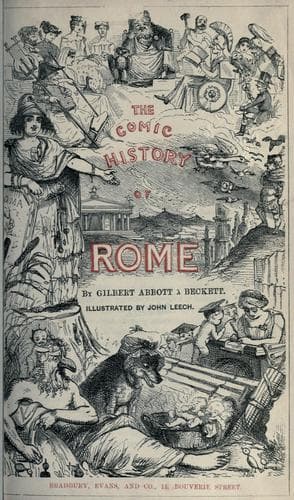
The Comic History of RomeÀ Beckett, Gilbert Abbott
History
The Comic History of Rome
À Beckett, Gilbert Abbott
Rome -- History -- Humor; Wit and humor, Pictorial
The Servile War had not yet ceased, when Attalus, the King of Pergamus,
died, and left no sign; for there was no succeeding king's head for the
crown of Pergamus to rest upon. It was fortunate, perhaps, that Attalus
left no heir; for had there been any inheritor of his qualities as well
as his title, the perpetuation of a nuisance would have been the
deplorable consequence. The man was so thoroughly wicked that it is
charity to pronounce him mad, and we accordingly set him down as a
lunatic, though we feel scarcely justified in acquitting him of his many
crimes on the single ground of insanity. He is said to have been so much
addicted to the practice of poisoning his relations, that he found it
cheaper to grow his own plants; and he cultivated the hemlock, or the
night-shade, as others grew their own faba or cicer, their beans and
chickweed. Death lurked at the root of everything his garden contained,
and it is probable that he sent many a present of putative mushrooms to
his unsuspecting kindred. So odious had he become, that it is said he
would have been murdered, if he had not died a little too soon for the
arrangements of the assassins to be completed. Having been in the habit
of expressing his will very briefly in his lifetime, it is not
surprising that he should have left at his death a will, so short, that
it purported to say in four letters all he desired. His last testament
was comprised in the characters P. R. H. E.; and all his property was
supposed to be represented in this small collection of capitals. The
Romans affecting to be initiated in the meaning of these initials,
declared them to signify, _Populus Romanus hæres est_, Let the Roman
people be the heirs of my property. Regarding these letters as letters
of administration, the Romans possessed themselves of all the effects of
Attalus; but the will was disputed by the next of kin, one Aristonicus,
a natural brother, whose claim to succeed, as a member of the testator's
line, was stifled by a rope, with which the unfortunate claimant was
cruelly strangled.
[Illustration: Arrest of Eunus.]
Pergamus became a Roman province under the name of Asia Proper--a
species of appropriation which there was nothing to justify.
Rome was now in the position of a man who had outgrown his strength, or
rather of an adult still wearing the clothes of its infancy. Its
measures had been adapted to a social body which had since spread itself
in all directions, while the constitution, with which it was clothed,
had not been extended to the new growth; and the extreme points of the
Republic were therefore reduced to all sorts of extremities. The people
at large had become so miserably poor, that they were easily bribed to
become the tools of their own further abasement; and they were not only
ready to sell themselves for a mere nothing, but to lend themselves to
almost anything.
Public-domain text, read in full here on John Shaqi.
Reviews
Reviews
No reviews yet
Be the first to share your thoughts on this work.
Elsewhere in the archive
Join the Discussion
Join the discussion
Sign in to leave a comment or review.
Sign InorCreate an account