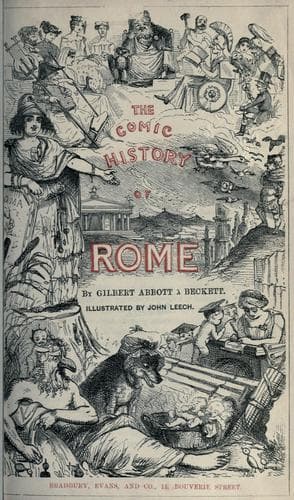
The Comic History of RomeÀ Beckett, Gilbert Abbott
History
The Comic History of Rome
À Beckett, Gilbert Abbott
Rome -- History -- Humor; Wit and humor, Pictorial
Notwithstanding the liberty which is declared by republicans to be
inseparable from the Republican form of Government, laws were passed to
restrain the liberty of private action in the days of the Roman
Commonwealth. By the Orchian law, made in the year of the city 572 (B.C.
181), the number of guests that might sit down to dinner was limited:
and as a further illustration of republican freedom, it may be mentioned
that the entertainer was obliged to keep open his doors, so that all
who were freely-and-easily inclined might enter his house to see that
the law was complied with. Twenty years later, it was decreed by the law
of Fannius, that no entertainment should cost more than one hundred
asses, or six shillings and five-pence farthing, on high days and
holidays; on ten other days in the month, the meal was not to exceed
thirty asses, or one and eleven-pence farthing; but on ordinary
occasions seven-pence farthing was the figure to which even the richest
man was to limit the cost of his dinner. The law not only interfered
with the bill of expenses, but with the bill of fare; and, under the
Consulship of M. Scaurus, the dormouse was excluded from the
dinner-table as an enervating luxury. Vegetables were allowed to any
extent, and bread might be eaten at--or even beyond--discretion.
To such a ridiculous extent did the Romans carry their interference with
the private expenditure of each other, that when Crassus and Cn.
Demetrius were Censors, they endeavoured in the most absurd manner to
damage each other's popularity. Demetrius publicly charged Crassus with
having been guilty of extravagance for going into mourning on the death
of a favourite fish; and Crassus retorted by declaring that Demetrius
had lost three wives without exhibiting signs of mourning for any one of
them.[64]
FOOTNOTE:
[64] Macrobius, Saturnal., lib. ii., c. 1.
CHAPTER THE TWENTY-THIRD
THE GRACCHI AND THEIR MOTHER. RISE AND FALL OF TIBERIUS AND CAIUS
GRACCHUS.
Public-domain text, read in full here on John Shaqi.
Reviews
Reviews
No reviews yet
Be the first to share your thoughts on this work.
Elsewhere in the archive
Join the Discussion
Join the discussion
Sign in to leave a comment or review.
Sign InorCreate an account