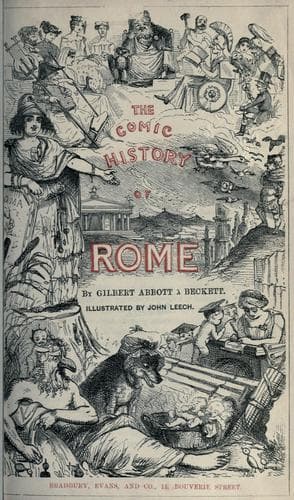
The Comic History of RomeÀ Beckett, Gilbert Abbott
History
The Comic History of Rome
À Beckett, Gilbert Abbott
Rome -- History -- Humor; Wit and humor, Pictorial
A people trained to live chiefly on spoils taken from others must be
continually spoiling itself for any peaceful occupation; and those whose
chief support is the sword, must be always destroying the food they live
upon. When foreign means are exhausted, it becomes necessary to look at
home, and those who have existed by robbing strangers, are no sooner
deprived of their external sources of support, than they begin to rob
each other. Such was the order--or rather the disorder--of things in
Rome, where wealth had got into the hands of the few, and the social
fabric, like a building too heavy at the top, was in immediate danger of
a downfall. There were large classes of persons who were assured that
they were perfectly free; but, though enjoying the freedom of air
itself, they found in it no element of comfort, when they had nothing
more substantial than the air to live upon. Deprived of every inch of
land, there was but a flatulent sort of satisfaction in the enjoyment of
the atmosphere, nor could the most long-winded of orators impress the
people with the idea that life could be maintained by simply imbibing
the breath of liberty. They were informed that they were the lords of
the earth;[65] but this mockery of respect was simply insulting the
emptiness of their mouths by a scarcely less empty title. The plebeians
were like a number of ciphers without a preliminary figure, and, though
possessing all the materials of strength in their vast body, were
powerless until a head could be found for them. This at length appeared
in the person of Tib. Sempronius Gracchus, the grandson of the elder
Scipio, and as two heads are said to be better than one, Tib. united his
brother Caius with him in the office of leader to the great plebeian
movement.
The elder Gracchus had been tutored by his mother Cornelia--one of the
earliest members of the ancient and honourable order of blue-stockings.
She had superintended the education of her children, and had personally
tutored them in eloquence; an art of which the female tongue is
peculiarly capable. Her own house was the resort of some of the first
philosophers of the day, who, like many modern philosophers, were
thoroughly impressed with the idea that the way to penetrate the
youthful mind, is to continue for ever boring it. In this manner the
understandings of the young Gracchi had been thoroughly drilled, and the
treasures of science had been admitted at so many apertures, that the
only fear was lest the treasures, through some of the numerous
openings by which they had got into the mind, might find their way out
again.
[Illustration: _The Mother of the Gracchi._]
Public-domain text, read in full here on John Shaqi.
Reviews
Reviews
No reviews yet
Be the first to share your thoughts on this work.
Elsewhere in the archive
Join the Discussion
Join the discussion
Sign in to leave a comment or review.
Sign InorCreate an account