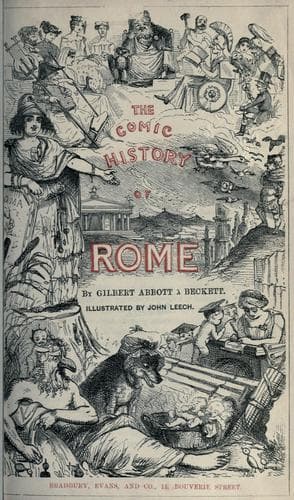
The Comic History of RomeÀ Beckett, Gilbert Abbott
History
The Comic History of Rome
À Beckett, Gilbert Abbott
Rome -- History -- Humor; Wit and humor, Pictorial
Marius celebrated the success of the day in a magnificent triumph, and
paraded, among his trophies, a Cimbric king of such a gigantic height,
that, notwithstanding his humiliating position, everybody looked up to
him.
For the sixth time the consulship was bestowed on Marius, though not
without a vast amount of bribery on the part of the successful
candidate, who, while he corrupted the electors with one hand, raised a
temple to Virtue and Honour with the other. He had now become so
inflated with vanity, that he came swelling into the Senate in his
triumphal robes; but he was so coldly received, that he pretended he
had forgotten to change his dress, though his astonishment was as
clearly put on as his objectionable attire. He caused to be engraved
upon his buckler the image of a Gaul pulling out his tongue; an allegory
rather difficult to comprehend, except by adopting the somewhat vulgar
reading, that the design was emblematical of the fact that, after the
victory of Marius, the Gaul might as well pull out his tongue at once,
as there could be no chance of his giving a licking to the Romans.
Marius was so popular, that he was acknowledged as the third founder of
Rome; Romulus, Camillus, and himself being figuratively regarded as so
many bricks that the city had been built upon.
Success had rendered Marius so arrogant, that he committed many illegal
acts, declaring that, amid the clashing of the swords of war, the silent
motion of the sword of justice could neither be heard nor attended to.
His morbid appetite for mob popularity caused him to enter into a
disgraceful alliance with an unprincipled demagogue, named L. Appuleius
Saturninus, whose performances equalled his promises; but he always
promised one thing, and performed another. He adopted the extremely
liberal side in politics, and proposed, among other liberal measures,
that every member of the Senate should bind himself by an oath to
support some very liberal law for dealing with property, by taking it
from those who had it, and giving it to those who were ready to take it.
This friend of freedom suggested, further, that every senator attempting
to exercise a free will, should pay a heavy penalty. One of the
aristocratic party having ventured on proposing an amendment, was driven
from the Senate by a shower of missiles. Another having suggested that
he heard thunder--a sign at which the Assembly should have broken
up--was told that there would probably be some hail, with hail-stones of
real stone, if he opposed the project of Saturninus. Marius had the
courage to declare that he would never take the degrading oath; Metellus
seconded his resolution; and the whole Senate, with one voice--which
turned out, ultimately, to be _vox et præterea nihil_--swore that they
would never swear to what the people had dared to demand of them.
Notwithstanding this spirited proposition, Marius had not sufficient
bravery to brave the popular clamour, and his courage had died away
Public-domain text, read in full here on John Shaqi.
Reviews
Reviews
No reviews yet
Be the first to share your thoughts on this work.
Elsewhere in the archive
Join the Discussion
Join the discussion
Sign in to leave a comment or review.
Sign InorCreate an account