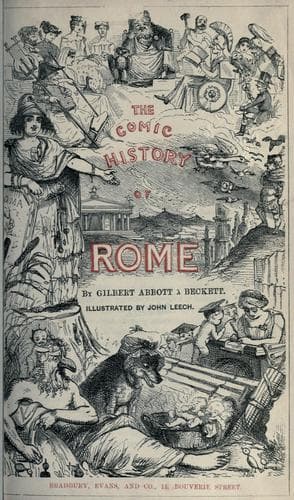
The Comic History of RomeÀ Beckett, Gilbert Abbott
History
The Comic History of Rome
À Beckett, Gilbert Abbott
Rome -- History -- Humor; Wit and humor, Pictorial
It says little to the credit of Rome that her dangers seemed to damp the
ambition of her citizens, and no one evinced an anxiety for the perilous
honours of the Consulship. Those among the aristocracy who claimed a
sort of prescriptive right to the government in times when there was
everything to be got, now that there was a prospect of everything being
lost, shrunk from the responsibility of a high position. The plebeian,
Marius, was declared to be the only man for the situation; and, instead
of being obliged to solicit the Consulship, it was thrust upon him even
before he had returned from Africa.
His first care was to get together an army capable of bearing the
fatigues of a military life, in preference to those who were only fit to
support its gaudy trappings. He enlisted large numbers of working men,
and tested their strength by putting into their hands a spade before he
entrusted them with a sword, subjecting them to all sorts of privations,
and putting them even upon reduced rations--an experiment that was by no
means rational. Many of the soldiers, who, under a generous diet, would
have become strong healthy men, dwindled to mere skeletons, and many of
the recruits were reduced so low that their strength was past
recruiting. Those who were able to stand against the fatigue, were hardy
enough to stand against anything; and, in order to give them the benefit
of a lengthy training, he refused to accept battle until a convenient
opportunity. He allowed the Teutoni to pass his camp, and, as they did
so, they inquired tauntingly if there were any messages or parcels for
Rome, as they--the Teutoni--were on their journey thither. Marius
pursued them to Aquæ Sextiæ--now Aix--and purposely pitched his camp in
such a place, that water could not be obtained without a fight for it.
Every soldier who went down to the river was obliged to draw his sword
as he drew the water he required, and, while he fought with one hand,
defended himself as well as he could with a bucket in the other. The
Teutoni were completely defeated, and rushed, for safety, to their
wagons; but all who remained in the rear, together with many who had got
into the van, were cut to pieces.
Marius had no sooner disposed of the Teutoni, than he heard that the
Cimbri were pouring themselves all over the plains of Lombardy; and,
proceeding to meet them, he threatened to "turn their bones into
whitening for the fields," a menace that proves the practice of bone
manuring to be an agricultural process of great antiquity. He drew up
his army near Verona, at a place called the Campi Raudii, and found the
front ranks of the Cimbri linked together by chains,--an arrangement
adopted, probably, to prevent their running away, and making them feel
bound to stand against the enemy. Marius, with considerable tact, got
into such a position that the sun got into their eyes, and the wind blew
their noses. Unable to look their danger in the face, they were sent
winking and sneezing to destruction.
Public-domain text, read in full here on John Shaqi.
Reviews
Reviews
No reviews yet
Be the first to share your thoughts on this work.
Elsewhere in the archive
Join the Discussion
Join the discussion
Sign in to leave a comment or review.
Sign InorCreate an account