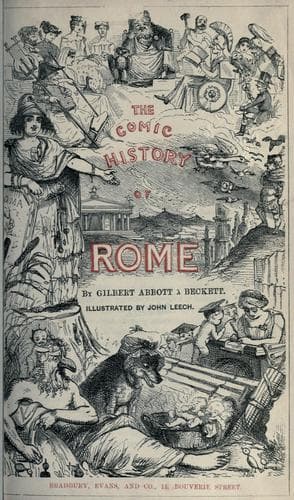
The Comic History of RomeÀ Beckett, Gilbert Abbott
History
The Comic History of Rome
À Beckett, Gilbert Abbott
Rome -- History -- Humor; Wit and humor, Pictorial
Law Reform, and the extension of the franchise, had now become the two
great questions of the day; for the tribunals were courts of in-justice,
and the Italians thought that as much weight ought to be allowed to the
Italic as to the Roman character. It was the policy of the Senate to
purchase popularity at almost any price, and the members were ready to
outbid each other by the most extravagant offers, for the object of
their ignoble competition. Among the boldest of the bidders was M.
Livius Drusus, the son of old Drusus--the colleague of Gracchus--who
seems to have inherited his father's propensity for sacrificing all his
principle, in order to convert it into political capital. Young Drusus
is said to have been a remarkable man, because, when Quæstor in Asia, he
dispensed with the insignia of office, preferring to depend upon his own
personal bearing, and, perhaps, wishing to save the cost of those
externals which, sometimes, take from the public functionary quite as
much in the way of emolument, as they bring him in the way of dignity.
He had been elected to the Tribuneship, and in that capacity he did
everything he could to catch the breath of popular applause, which often
sullies the brightness of the object that seeks to reflect the
evanescent vapour.
One of the principal propositions of M. Livius Drusus was, that the
judges should be liable to be brought to trial themselves, for their
mode of conducting the trials of others. This attempt to undermine the
independence of the judicial order, was shown to be so fatal to the
administration of justice, that the people, who, after all, require only
to be convinced of what is right in order to take the right direction,
repudiated the proposal which Drusus had intended to be the means of
misleading them, and obtaining for himself--under false pretences--a
little additional popularity. It was pointed out to them, that a judge
who felt every trial at which he was presiding to be his own, and who
would be always divided between the calm demands of justice on one hand,
and the unreasoning voice of public clamour on the other, would feel
himself exposed to a pressure that would prevent him from maintaining an
upright position. Notwithstanding his failure in this instance, M.
Livius Drusus made himself the champion of the movement, and opened his
house every evening, to give political advice gratis to all who were
desirous of consulting him. He was engaged in this manner during one of
his evenings at home, when he was suddenly stabbed by a shoe-maker's
knife; and though the assassin was never discovered, the blow was
supposed to have been connived at by some persons who had persuaded the
cobbler to risk his awl in the dangerous effort. As a Roman could never
die without a claptrap in his mouth, Drusus was of course prepared with
a neat speech on the melancholy occasion. Having ejaculated, "Oh! thou
ungrateful Republic, thou hast never lost a more devoted son!" he
Public-domain text, read in full here on John Shaqi.
Reviews
Reviews
No reviews yet
Be the first to share your thoughts on this work.
Elsewhere in the archive
Join the Discussion
Join the discussion
Sign in to leave a comment or review.
Sign InorCreate an account