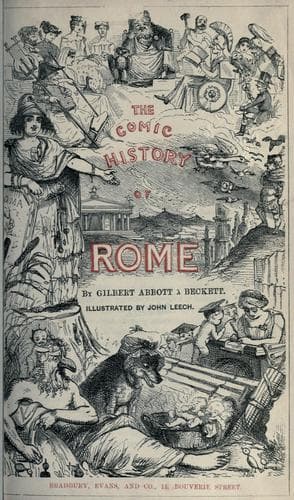
The Comic History of RomeÀ Beckett, Gilbert Abbott
History
The Comic History of Rome
À Beckett, Gilbert Abbott
Rome -- History -- Humor; Wit and humor, Pictorial
arranged his toga in becoming folds, and bowing to circumstances--
bowing, perhaps, to the audience as well--he gracefully expired.
[Illustration: Drusus is stabbed, and expires gracefully.]
The Italians, being deprived of the support of Drusus, were more than
ever oppressed, and the multitude, whom it is customary to regard as
synonymous with the liberal party, became vehement in denouncing the
idea of allowing an equality of rights to all classes of Roman subjects.
The Italians, therefore, came to the resolution, that if Rome was not to
exist for them, it should not exist at all; but that they would either
bring the city to the ground, or raise themselves from the dust to which
injustice had lowered them. Several of the Italian nations formed
themselves into a league, but never did a league go to such lengths as
the one in question; for some of its members murdered the prætor,
Servilius Cœpio, and his legate, who attended a meeting in the hope of
conciliation at the Theatre of Asculum.
The next step of the Italians was to start a republic of their own,
under the name of Italica; and by way of giving it an imposing
appearance, it was to have a senate five hundred strong--though in a
deliberative assembly numbers are not so much an element of strength as
of weakness. It was to have two annual consuls, and no less than twelve
prætors; it being perhaps the policy of the framers of the constitution
to have plenty of patronage to tempt adherents to the new government.
The two consuls first appointed were Silo Popædius, a Marsian, and C.
Papius Mutilus, a Samnite, who took the field with great vigour, but
took little else in the first instance; for Silo fell in the fight,
though Mutilus, whose army was terribly mutilated, obtained some success
in Campania.
Though the Italians had commenced their operations as fast friends, they
loosened considerably in their friendship as the war advanced, and made
separate treaties of peace, by which Rome was enabled to deal with them
piecemeal, instead of being compelled to stand against their united
efforts. The Samnites evinced their old obstinacy, and waited, as usual,
to be cut to pieces, before they abandoned the hope of holding together.
When the sword had been busy among them for three years, there remained
still a mass of sufficient importance to induce the Romans to offer the
franchise to all who would lay down their arms; and of this proposal the
Samnites at last reluctantly availed themselves.
Public-domain text, read in full here on John Shaqi.
Reviews
Reviews
No reviews yet
Be the first to share your thoughts on this work.
Elsewhere in the archive
Join the Discussion
Join the discussion
Sign in to leave a comment or review.
Sign InorCreate an account