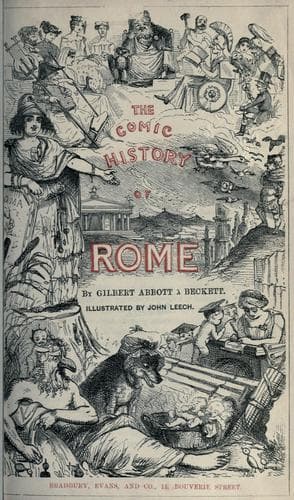
The Comic History of RomeÀ Beckett, Gilbert Abbott
History
The Comic History of Rome
À Beckett, Gilbert Abbott
Rome -- History -- Humor; Wit and humor, Pictorial
Rome having acquired a large accession of new citizens, was puzzled to
determine what to do with them. Had they been distributed amongst the
thirty-five country tribes, the old members would have been swamped by
the new, and the latter were, therefore, formed into--some say six, some
say eight, and some say fifteen separate bodies. Such is the
disagreement of the learned doctors on this head, that we cannot put
confidence in one without discrediting two; and we consequently take the
more impartial course of believing none of them. So great is the
discrepancy of the authorities on nearly every point, that, for the sake
of history, we can only hope they do not go for their facts to the same
sources which have supplied their figures. It is true that they usually
profess to deal with round numbers alone; and perhaps if every number
employed were literally round, it would represent the sum of what is
known with certainty on the subjects that are spoken of.
The fact, however, is indisputable, that, in the times to which our
history relates, the weaker states were the prey of the stronger,--might
overcame right; and the only mode by which a small society could save
itself from destruction by one power, was by the sale of its
independence to another. Those places which were incompetent to practise
the noble art of self-defence, could only obtain protection against
violence on the right hand, by submitting to robbery on the left; and
the Romans, who were usually appealed to for aid, always plentifully
helped themselves at the cost of those by whom their help was required.
By the foreign policy of Rome, ambassadors were always planted in all
places of importance, to interfere in the quarrels between nations and
their kings; and the ambassadors took care, by fomenting quarrels, that
there should be no lack of material for their diplomacy. The cost of
intervention fell heavily on those upon whom it was bestowed, but it
eventually helped to ruin Rome itself; for neglect of one's own affairs
is the inevitable consequence of interfering with the affairs of one's
neighbours. The professed object of this meddling on the part of the
great republic, was to give to other states the benefit of freedom.
There is, however, no slavery more abject than that which induces a
nation to accept a foreign, instead of a domestic, tyranny. Those who
are willing to import their independence from abroad, will never find it
flourish at home; and there is not a more melancholy object--as recent
events have proved--than a transplanted tree of liberty.
FOOTNOTES:
[68] Sallust, Jugurthine War, c. vi.
CHAPTER THE TWENTY-FIFTH.
MITHRIDATES, SULLA, MARIUS, CINNA, ET CÆTERA.
[Illustration]
Following the order of dates, we come to Mithridates, the son of old
Mithridates the Fifth, surnamed Eupator, who had been a fast ally of
Rome; but his son, who was much faster in another sense, soon came to
hostilities.
Public-domain text, read in full here on John Shaqi.
Reviews
Reviews
No reviews yet
Be the first to share your thoughts on this work.
Elsewhere in the archive
Join the Discussion
Join the discussion
Sign in to leave a comment or review.
Sign InorCreate an account