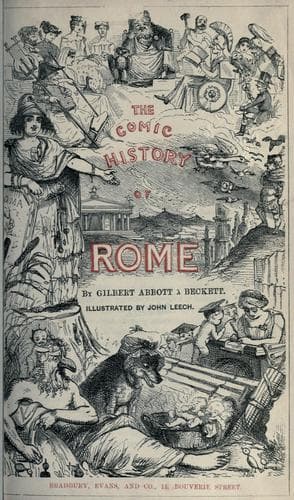
The Comic History of RomeÀ Beckett, Gilbert Abbott
History
The Comic History of Rome
À Beckett, Gilbert Abbott
Rome -- History -- Humor; Wit and humor, Pictorial
Such had been the education and pursuits of the young man whom we find
occupying the throne of Pontus, and interfering in the affairs of
Cappadocia, to which he undertook to supply a king, from his own family,
whenever a vacancy happened. Rome, also, began to take an interest in
Cappadocia, and the only party without a voice in the affair, consisted
of the Cappadocians. They were assailed with the offer of freedom and a
republic at the point of the sword, on one side,--while, on the other,
they were asked to pin their faith to a monarchy which would otherwise
be pinned to them by the blades of a foreign army. The Cappadocians had
a wholesome horror of republican freedom, especially when imported from
abroad; and Rome, therefore, sent them a king, who was accepted until
his throne was overthrown by Mithridates--the Cappadocians having to pay
a heavy fine on each change of government.
The king, who was thoroughly put out by Mithridates, applied to Rome,
which raised an army in three divisions; but the Romans were so hated in
Asia Minor, that they encountered every opposition from the inhabitants.
Appius and Aquilinus, who were leaders of two of the divisions, soon
fell into the hands of Mithridates, and it is said that he punished
their avarice by pouring melted gold down their throats; but this is
more than any one could swallow.
The Roman Senate, irritated by defeat, called upon L. Cornelius
Sulla--or Sylla, as, by an alteration of the first syllable, he is
sometimes called--to take the command of the army. The family boasted of
its antiquity, though one family must be quite as old as another, if
everybody's pedigree could be traced; and the real wonder would be to
find a man whose ancestors had a beginning, instead of the ordinary case
of one with an apparently endless line of progenitors. The family of
Cornelius Sulla claimed connection with that of Cornelius Rufinus, who,
in the year of Rome 540, instituted the Ludi Apollinares, in honour of
Apollo, and in conformity with the directions of the Sibylline books,
from which he had taken the name of Sibylla. This had, according to the
interpretation put upon it by family pride, been corrupted into Sulla;
and such is the empty boast of ancestry, that even corruption is eagerly
acknowledged as a proof of ancient lineage. The father of L. Cornelius
Sulla had left little--not even an unsullied name--to his son, but had
been equally wasteful of fortune and character. The boy was clever and
quick, but his speediness speedily degenerated into fastness. Having
neither morality nor means, he took a cheap apartment, where he
entertained a low set, and there was nothing to be envied either in his
room or his company.
In early life he had distinguished himself as a soldier in the
Jugurthine War; and he subsequently obtained the office of Prætor, in
which he won the affections of the people, by introducing into the
entertainments of the amphitheatre the extraordinary attraction of 100
real lions.
Public-domain text, read in full here on John Shaqi.
Reviews
Reviews
No reviews yet
Be the first to share your thoughts on this work.
Elsewhere in the archive
Join the Discussion
Join the discussion
Sign in to leave a comment or review.
Sign InorCreate an account