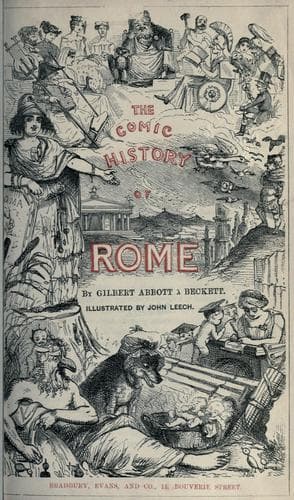
The Comic History of RomeÀ Beckett, Gilbert Abbott
History
The Comic History of Rome
À Beckett, Gilbert Abbott
Rome -- History -- Humor; Wit and humor, Pictorial
A feeble attempt was made to bolt the doors against Sulla and his
soldiers, but it was impossible to bar their entrance. As they marched
through the streets, they were assailed from the houses with showers
of brick, which, though very destructive, could not have been so
damaging as the modern mortar. Some of the inhabitants were armed with
slings, and now and then an arrow was discharged from a bow window.
Orders were immediately given to set fire to the quarters whence the
annoyance proceeded, and the directions were acted upon with that
indiscriminate ferocity which is too often displayed by an incensed
soldiery against an unarmed populace. The anger excited by the few was
vented on the unoffending many, and the troops performed, with savage
alacrity, the most humiliating service on which they could have been
employed--the butchery of their defenceless fellow-citizens.
[Illustration: "Who dares kill Marius?"]
The leaders, or, rather, the mis-leaders of the people in this miserable
conspiracy, were the first to seek their own safety in flight, and the
tribune P. Sulpicius, who had set the example of employing brute force,
evinced the most cowardly haste in running away from it, when he seemed
likely to become one of its victims. Marius made for the marshes near
Minturnæ, where he stuck in the mud, and covered his reputation with a
number of stains that are quite indelible. On being discovered in his
ignoble retreat, by those who had pursued him through thick and thin, he
was dragged to the town and lodged in the nearest station. A price had
been put upon his head, but the article does not seem to have been worth
much, for he had shown very little sense in the part he had been
playing. His gray hairs, or, perhaps, rather, his total baldness, still
commanded so much of sympathy, that nobody evinced a disposition to
become his executioner, until a Cimbric soldier undertook the
discreditable office. He approached the veteran with a drawn sword, but
Marius had got into a dark corner, and succeeded in frightening the
man-at-arms by putting on a voice of the most dismal character. The
soldier fancying himself in the presence of a ghost, failed in plucking
up a sufficient spirit; and when a moan was heard--inquiring, "Who dares
kill Caius Marius?" the would-be assassin, having flung down his sword,
ran away, exclaiming--"Not I, for one, at any rate!" The soldier, of
course, exaggerated the cause of his fears, and declared that the eyes
of Marius had appeared to him like two candles burning in their sockets.
The inhabitants of Minturnæ became as nervous as the panic-stricken
soldier, and put Marius on board a ship, which, after being tossed about
for several days, came to an anchor, or ran aground, high and dry, on
the fine old crusted port of Carthage. Here he rambled about the ruins,
and rested his aching head upon its broken temples. The Roman Governor,
Sextilius, not knowing what to do with such an embarrassing visitor,
Public-domain text, read in full here on John Shaqi.
Reviews
Reviews
No reviews yet
Be the first to share your thoughts on this work.
Elsewhere in the archive
Join the Discussion
Join the discussion
Sign in to leave a comment or review.
Sign InorCreate an account