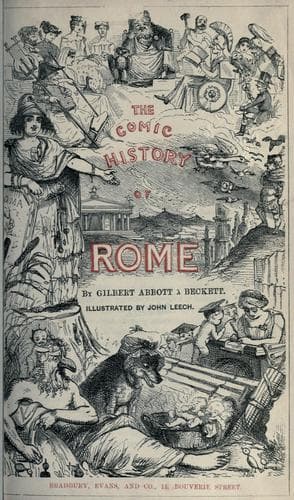
The Comic History of RomeÀ Beckett, Gilbert Abbott
History
The Comic History of Rome
À Beckett, Gilbert Abbott
Rome -- History -- Humor; Wit and humor, Pictorial
sent a messenger to request him to "move on;" but the exile, with a
dignified air, claimed his right to repose upon the dry rubbish. "Tell
thy master," he observed to the officer on duty, who had respectfully
told him he must "come out of that," in compliance with the orders of
the authorities,--"Tell thy master that thou hast seen Marius, sitting
on the ruins of Carthage." The intelligence was not new, but it seems to
have been rather startling, for it had the effect of causing Marius to
be allowed to remain; and we will, therefore, leave him there, while we
proceed with the march of our history.
Sulla having reduced the city to the most complete subjection, made a
merit of not pursuing his vengeance farther against the defenceless
inhabitants; and so great was his confidence in the efficacy of his
work, that he acquiesced in the appointment of L. Cornelius Cinna, a
partisan of Marius, to the consulship. Sulla proceeded to Greece, where
he blockaded Athens, whose inhabitants he plundered, as a practical
acknowledgment of their worth; and he spared their lives, to show how he
valued their ancestors. He manifested his respect for their arts by
robbing their city of its chief ornaments; and he paid their learning
the compliment of stealing their principal libraries.
In the meantime Cinna had entered on the duties of the consulship at
Rome, but there the truth of the maxim, that two heads are better than
one, was rendered extremely doubtful by the constant dissensions between
himself and his colleague. The latter was Cn. Octavius, who opposed
whatever the former recommended; and while one tried to carry his
measures by brute force, the other endeavoured to defeat them by armed
violence. Cinna appealed to the mob, and Octavius trusted to the army,
both forces being the principal movers under a republican rule or
misrule, and both being equally repugnant to the spirit of
constitutional government. The arms of such a republic might have for
its supporters the bludgeon and the sword, with the figure of Liberty
battered and bleeding, slashed and sabred, gagged and fettered, in the
middle. Octavius and the sword had, on this occasion, got the upper
hand; and Cinna, the clubbist, was glad to break his bludgeon or cut his
stick, in flying from the city.
[Illustration: Marius in the Ruins of Carthage.]
Public-domain text, read in full here on John Shaqi.
Reviews
Reviews
No reviews yet
Be the first to share your thoughts on this work.
Elsewhere in the archive
Join the Discussion
Join the discussion
Sign in to leave a comment or review.
Sign InorCreate an account