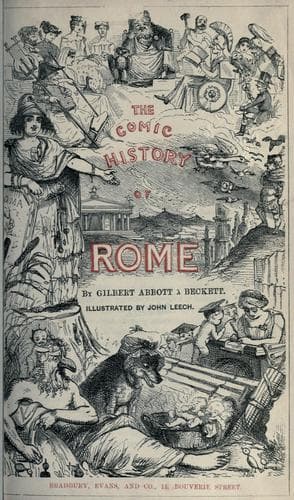
The Comic History of RomeÀ Beckett, Gilbert Abbott
History
The Comic History of Rome
À Beckett, Gilbert Abbott
Rome -- History -- Humor; Wit and humor, Pictorial
The Senate decreed that he had forfeited the consulship, and Cinna,
having been well received in the Italian towns, decreed that the Senate
had forfeited their authority. The Government was thus reduced to two
negatives, which could not make an affirmative; and in the midst of a
theoretical perfection of republican forms, there existed only the
substance of practical anarchy. The inhabitants of the Capitol, with the
sword at their throats, elected a Consul, who was, of course, declared
by the executive to be their free choice; while the people in the
provinces protested, as loudly as they dared, against the violence that
had been done to all the principles of law and liberty. Cinna, who had
possessed himself of large sums of public money, employed bribes and
promises to get himself acknowledged as the lawful Consul, for it is
customary with despotism, acting under the name of freedom, to rob the
people with one hand, in order to corrupt them with the other.
The veteran Marius, who, after making his bed on the ruins of Carthage,
was not too anxious to lie there, had been wanted to join the party of
Cinna, and the great captain of the age was received with enthusiasm, in
consideration of the great age of the captain. Papirius Carbo and Q.
Sertorius also gave in their adhesion; but Cn. Pompeius, who was
stationed with an army at Umbria, waited to see which side would pay him
best, and of those who would bid the highest, he was prepared to do the
bidding. Marius, in the meanwhile, landed in Tuscany with a few friends;
but to excite commiseration, he dressed himself in rags, which was,
indeed, putting on the garb of poverty. He spoke so repeatedly of his
reverses, and touched so frequently on his old clothes, that the subject
was completely threadbare. Rags are seldom attractive, but in this
instance, they were successful in obtaining for the wearer a large crowd
of followers.
Cn. Pompeius had at length consented to espouse the cause of the Senate,
but the alliance was one of interest on his side, for he would not
espouse anything without a very large pecuniary settlement having been
made in his favour. He met the army of Cinna under the walls of Rome,
but both forces were enfeebled by sickness. Each party proceeded to do
its best, but the soldiers on both sides were so wretchedly ill, that
none of them could, for one moment, stand at ease; and all were much
fitter to be in bed than in battle. A storm did sad havoc among the
defenders of Rome, and a flash of lightning falling naturally upon the
conductor of the army, caused the death of Cn. Pompeius. The gates of
the city were thrown open, Cinna was restored to the Consulship, and
though there had been an understanding that no blood should be shed,
Marius set a band of slaves and mercenaries upon the defenceless people.
Public-domain text, read in full here on John Shaqi.
Reviews
Reviews
No reviews yet
Be the first to share your thoughts on this work.
Elsewhere in the archive
Join the Discussion
Join the discussion
Sign in to leave a comment or review.
Sign InorCreate an account