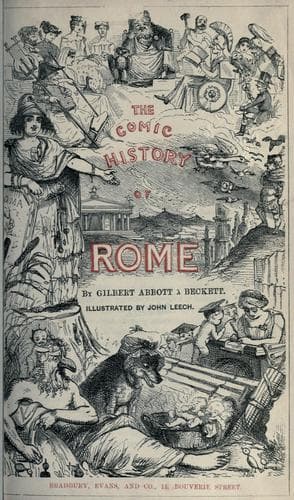
The Comic History of RomeÀ Beckett, Gilbert Abbott
History
The Comic History of Rome
À Beckett, Gilbert Abbott
Rome -- History -- Humor; Wit and humor, Pictorial
It was necessary to amuse the masses by what are termed liberal
measures, and as an excess of liberality, it was proposed that every
debtor, paying one fourth of his debt, should be released from all
further liability to his creditor. This was sure to be a popular act in
a country already ruined by political agitation, and the despotism to
which it frequently leads; and, as the debtors were by far the most
numerous class, a sort of general Insolvent Act was hailed with
acclamations by a bankrupt community.
Sulla, who was still in Greece, refused his allegiance to the despot at
home, and L. Valerius Flaccus was sent to supersede him in the command
of the army. Flaccus was not popular with his soldiers, and as the head
of the Government had set the example of setting aside all law by a
_coup d'état_, an imitator was soon found in the person of one Flavius
Fimbria, a lieutenant, who, by a _coup de tête_, got rid of his
obnoxious general. Flaccus being thus disposed of, Fimbria promoted
himself to the chief command; but, cowardice and cruelty going hand in
hand, he took his own life on hearing that Sulla was setting out against
him. The soldiers of Fimbria, with the most revolting faithlessness,
revolted to Sulla, who was now master of Asia. He called upon the
conquered nation for 20,000 talents, and as the subdued people had not
so large a sum by them, they were obliged to borrow it with one hand at
enormous interest, in order to pay it with the other. The Roman
capitalists lent the cash, and the Roman soldiers assisted them with
their swords to draw a ruinous per-centage from the unfortunate
borrowers. Sulla now prepared to march upon Rome, where Cinna had
re-elected himself as Consul, in conjunction with one Papirius Carbo, a
political incendiary, who acted like so much touch-paper and coal upon
the flame of discord. Intending to meet their rival, they proceeded
with an army into Italy; but the soldiers no sooner found themselves on
the Italian soil, than they declared their determination to remain
there. Cinna called them together, and endeavoured to persuade them to
go forward, but even when he gave the word of command there was no
advance on his bidding. From passive resistance they proceeded to active
insubordination, and, denouncing him as a tyrant whom it was high time
to see through, they perforated him with their swords in several places.
On the death of Cinna, legal authority began to raise its humbled head,
and Carbo was summoned to hold a Comitia at Rome; but on the day
appointed, the attendance of voters not promising a satisfactory result,
the augurs declared the auspices unfavourable, and dissolved the
meeting.
Public-domain text, read in full here on John Shaqi.
Reviews
Reviews
No reviews yet
Be the first to share your thoughts on this work.
Elsewhere in the archive
Join the Discussion
Join the discussion
Sign in to leave a comment or review.
Sign InorCreate an account