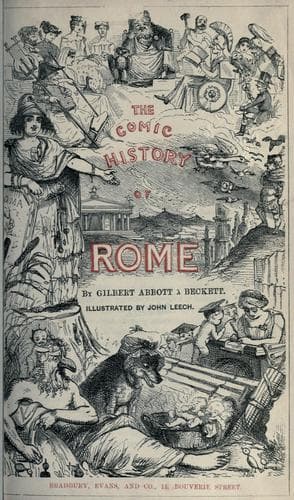
The Comic History of RomeÀ Beckett, Gilbert Abbott
History
The Comic History of Rome
À Beckett, Gilbert Abbott
Rome -- History -- Humor; Wit and humor, Pictorial
He next turned his attention to L. Scipio, whose army went over in a
body to the side of Sulla, while Scipio and his son were sitting
together, talking over general matters in the tent of the general. L.
Scipio had despatched his son with directions for the right division,
when the youth returned to say, that of the right division, there was
not one man left; and when Scipio himself went to look after his men,
he found there was not one remaining, even for the look of the thing,
to mount guard at the tent of their commander. He, of course, proposed a
series of strong resolutions, seconded by his son, that all those who
had joined Sulla were enemies to the state; but the state in which he
then was, rendered his denunciations idle, if not ridiculous. The
position of Sulla was becoming rather alarming to the party of Carbo,
who caused himself to be appointed Consul, for the year B.C. 82, in
conjunction with young C. Marius, who, as the heir of his father, had
inherited a large stock of wickedness. Cn. Pompeius had already sent in
his adhesion to Sulla, who had received him as a very promising young
man, for he had a fair share of popularity, and a good amount of
property. Young Pompey was opposed to old Carbo, and the former so
harassed the latter, that his temper, always sour, became equal to
carbonic acid in its inflammable tendency.
Sulla took young Marius in hand, and followed him up to a place called
Sacriportus, where, in consequence of a dream--for the ancients were
addicted to taking advice with their eyes shut--an attack by the former
on the latter was resolved upon. Sulla ordered his soldiers to advance,
but they were so fatigued that they fell asleep on the road, and caused
their leader to wonder what they could possibly be dreaming of. Instead
of their being equipped in the arms of the warrior, they were stretched
in the arms of Somnus, and Sulla, though reluctant to go counter to his
dream, perceived the folly of marching to battle with a somnambulist
army. He gave orders, therefore, to halt, and the men had commenced
digging the foundations for a camp, when the cavalry of Marius rode up
for the purpose of annoying them. Irritated by the conduct of the
enemy's horse, the soldiers of Sulla kicked against it, and even while
engaged in their work, picked out, with their pickaxes, a few of the
foremost of the Marian army. This led to a general engagement, in which
Sulla's forces forgot their fatigue, and pursued the enemy to the
neighbouring town of Præneste, the gates of which were shut in such
haste, that all the fugitives had not time to get in, and Marius himself
was pulled up by a rope over the wall, together with a few immediate
hangers-on, who had tied themselves to his fortunes. Sulla is said to
have slain 20,000 men, and to have taken 8000 prisoners, while he lost
only twenty-three; but as he is his own authority for the statement,[71]
we must take in a purely figurative sense many of his figures.
Public-domain text, read in full here on John Shaqi.
Reviews
Reviews
No reviews yet
Be the first to share your thoughts on this work.
Elsewhere in the archive
Join the Discussion
Join the discussion
Sign in to leave a comment or review.
Sign InorCreate an account