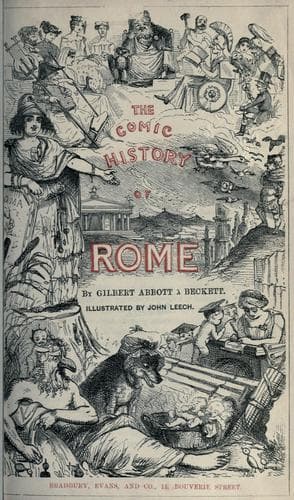
The Comic History of RomeÀ Beckett, Gilbert Abbott
History
The Comic History of Rome
À Beckett, Gilbert Abbott
Rome -- History -- Humor; Wit and humor, Pictorial
The Marian party, fearing that the successes of Sulla might encourage
resistance to the despotism still prevailing at Rome, determined on
getting rid of the principal politicians of the day, the heads of the
National Assembly of the period. The modern practice might have been to
have shut up the place of meeting, and prevent the members, by armed
force, from going in--slaughtering them, of course, in case of their
perseverance; but the Marian policy was to summon them to the Curia
Hostilia, and having got them in, to butcher those who attempted to go
out again.
The prætor, L. Damasippus, was entrusted with this sanguinary business;
and every eminent politician, who was suspected of having an independent
opinion of his own, was at once massacred. This step was declared to be
necessary to give strength to the Government, and to insure the
unanimity of the nation, by cutting the throats of all who ventured to
be of a way of thinking contrary to that of the ruling power.
Unfortunately, some of the best and wisest men of the day were blind to
the virtues of the chief of the republic; and the whole of these,
including Q. Mucius Scævola, the eminent jurist, were unceremoniously
sacrificed.
The news of the success of Sulla at Sacriportus, caused a panic among
those who had been combining the butcher's business with that of
government at Rome, and the perpetrators tried to fly when they heard
the enemy was approaching the city. Sulla, leaving Lucretius Ofella to
keep watch at the gates of Præneste, lest Marius should attempt to creep
out, marched in person on the capital. Directing his steps towards the
Colline gate, he found there an army of those same Samnites, who had
been previously cut into so many pieces, and who were ready to be cut
into so many more, should occasion require the alarming sacrifice. Their
general, Pontius Telesinus, rode in front of them, entreating them to
come and be killed for positively the last time; and the dux had
sufficient influence to induce them to rush like a flock of geese on
their own destruction. The victory of Sulla was complete; and Pontius
Telesinus having been overlooked by the foe in the heat of battle,
supplied the omission in the business of the day by making away with
himself--after the usual cowardly fashion of the heroes of antiquity.
Sulla's success seemed only to have effected a change of tyrants; and
his conduct proved that the monster grievance of Rome was the series of
inhuman monsters who had got hold of the government. The atrocities
attributed to Sulla are, however, so enormous, as almost to border on
the burlesque; and it is comfortable to feel in the exaggeration a
ground for hope that in the account furnished by the historians, much
may fall under the head of "Errors excepted."
Public-domain text, read in full here on John Shaqi.
Reviews
Reviews
No reviews yet
Be the first to share your thoughts on this work.
Elsewhere in the archive
Join the Discussion
Join the discussion
Sign in to leave a comment or review.
Sign InorCreate an account