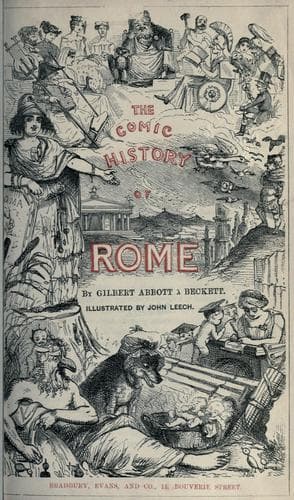
The Comic History of RomeÀ Beckett, Gilbert Abbott
History
The Comic History of Rome
À Beckett, Gilbert Abbott
Rome -- History -- Humor; Wit and humor, Pictorial
The senate, which had been cut down by assassination to suit the views
of Sulla, elected L. Valerius Flaccus as interrex, who immediately
caused Sulla to be invested with the power of doing whatever he liked,
as long as he liked; or, to use the official phraseology, made him
dictator for an unlimited period.
On receiving his appointment, the first measure of Sulla was to reward
the tools who had assisted him, and L. Valerius Flaccus was immediately
made master of the horse, while the military murderers, who had acted as
executioners in the execution of his plans, received grants of land in
the places which had been unfavourable to the tyrant. He courted a
certain sort of popularity by extending the suffrage to some 10,000
emancipated slaves, who retained enough of their slavishness to cause
them to vote as their master desired. He affected to reconstitute the
legislative body which he had illegally destroyed, and he sent into it a
quantity of that noxious scum which, in the troubled waters of
revolution, is frequently cast up to the surface of society.
Having established his position through the brutality of one part of the
people, and the cowardice of the other, he set about the business of a
reformer; and, though he did much harm, the little good that he
accomplished must not be denied to him. Being a despot by nature, he
limited, as far as he could, the popular element in the constitution, by
curtailing the power of the tribunes; and he increased the government
patronage by adding to the number of pontiffs and augurs, so that he
might have the privilege of appointment to lucrative, but useless,
offices. His changes in the criminal code were, however, really
beneficial, for he made murder, whether committed by poison or violence,
a crime by law; and, indeed, it was necessary that the point should be
clearly defined, for military murders at the hands of the executive had
been so numerous that it was reasonably doubted whether human life was
henceforth to be protected at all by the government. Many old laws were
re-enacted, though they had never been repealed; but the usurpers of
power had so thoroughly trampled on every legal form, that it was
impossible to know which of the laws were to be regarded as imperative
on the people.
Public-domain text, read in full here on John Shaqi.
Reviews
Reviews
No reviews yet
Be the first to share your thoughts on this work.
Elsewhere in the archive
Join the Discussion
Join the discussion
Sign in to leave a comment or review.
Sign InorCreate an account