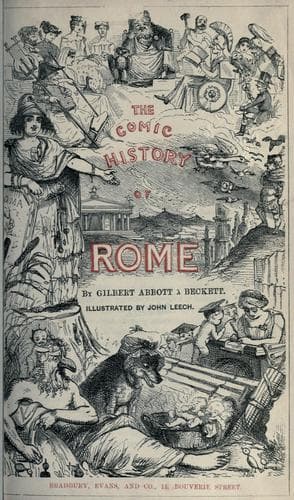
The Comic History of RomeÀ Beckett, Gilbert Abbott
History
The Comic History of Rome
À Beckett, Gilbert Abbott
Rome -- History -- Humor; Wit and humor, Pictorial
It is said that 3000 of the enemy at Antennæ implored his mercy, which
he granted, on the understanding that they were to assassinate their
associates--a service that was performed with brutal eagerness. When the
3000 claimed their own pardon as a reward, they were, according to
Plutarch, conveyed to Rome, and butchered with a few thousand others,
who had the misfortune to differ in opinion with the chief of a
republican government.
It was found so extremely embarrassing to heads of families and others
who were liable every day or hour to be cut off, that it was at length
proposed, as a matter of convenience, that Sulla should save time by
publishing a short list, containing the few names of those whom he did
not intend to sacrifice. He replied, by bringing out a very long list of
those he did, which he stated to be merely the first number of a serial
work, which he did not pledge himself to complete within any particular
period. As every copyright is liable to be infringed, the work of Sulla
was the subject of numerous imitations; and there were many who made
lists of their own, containing names disagreeable to themselves; so that
no man could walk the streets without the chance of reading his own
death-warrant on the walls of the capital. Sulla, in many instances,
offered rewards for the heads of his victims, and his doors were beset
from morning till night with the cry of, "Butcher!" by those who called
for the sums they had earned as slaughtermen. Assassinations proceeded
to such a fearful degree, that Q. Catulus asked Sulla, in confidence,
whether it was the intention of the latter to spare any human being at
all? for there seemed a chance of his having no one left to rule over
but himself; and such a man was likely to find self-government
exceedingly difficult.
While these things were going on at Rome, Marius was besieged in
Præneste, from which he tried to make his escape through the common
sewer; a mode of insuring his life that was far from dignified. He,
however, was espied through an iron aperture, which was so grating to
his feelings, that he called upon his slave to run him through; when the
faithful fellow immediately bored him to death with a trusty and rusty
weapon.
Sulla, the perpetrator of all the acts of despotism and cruelty which
are above described, was without any legal authority, and had no more
right than the meanest subject of the republic to the power which he
exercised. His reign was a reign of terror, supported by the swords of a
sordid soldiery. Of the two Consuls, Marius was already dead; and Carbo,
being taken prisoner, was condemned to death; so that Carbo--the
blackness of whose conduct justified his title of the coal--was soon
reduced to ashes.
Public-domain text, read in full here on John Shaqi.
Reviews
Reviews
No reviews yet
Be the first to share your thoughts on this work.
Elsewhere in the archive
Join the Discussion
Join the discussion
Sign in to leave a comment or review.
Sign InorCreate an account