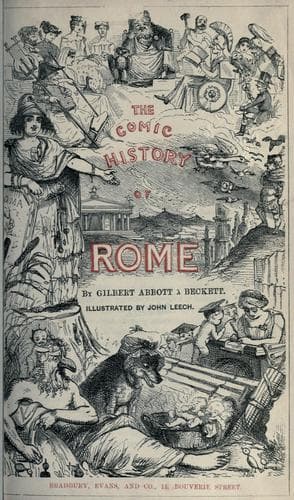
The Comic History of RomeÀ Beckett, Gilbert Abbott
History
The Comic History of Rome
À Beckett, Gilbert Abbott
Rome -- History -- Humor; Wit and humor, Pictorial
By another clause in the act, those insolvent debtors who had been
converted into "alarming sacrifices!" and were reduced to slavery,
because their creditors "must have cash," or its equivalent, were
restored to freedom. The ceremony of manumission was curious, and
comprised so many indignities done to the slave, that, although free, he
could not have been very easy under the process. He was first taken
before the Consul by his master, who gave him a blow on the cheek, which
was rather a back-handed mode of making an independent man of him. The
Consul then laid his wand about the insolvent's back, at the same time
declaring him perfectly free, and telling him to go about his
business--if he happened to have any. The beating having been gone
through, there was still more lathering to be endured; for the head of
the freedman was closely shaved, as a precaution, perhaps, against his
going mad on the attainment of his liberty. His release from his chains
was not complete until he had been deprived of his locks; and to crown
all, he was invested with that emblem of butchery in a political, as
well as a social point of view, the red cap of liberty.
During the internal quarrels of Rome, agriculture had been so thoroughly
neglected, that the harvest had completely fallen to the ground, or,
rather, had never come out of it. The husbandman had husbanded nothing,
either for himself or others; and as nothing had been sown but civil
dissension, there was nothing to reap but the fruit of it. The Romans,
who, until lately, had been thirsting for power, were now hungry for
food; and, to prevent the people from dying at home, envoys were sent to
scour the surrounding countries,--a process which involved many a brush
with the inhabitants. It is stated, by some historians, that, during the
famine, an order was forwarded to Gelo, of Syracuse, for corn, which
that individual was quite ready to supply, but for which he was so
thoroughly unbusiness-like as to refuse the money. The incident, though
utterly without commercial interest, would have been pleasing in a
different point of view, were it not for the stern realities of
chronology, which prove that Gelo could not have acted as a gratuitous
corn-dealer at the time specified, for he was not alive at the period.
Public-domain text, read in full here on John Shaqi.
Reviews
Reviews
No reviews yet
Be the first to share your thoughts on this work.
Elsewhere in the archive
Join the Discussion
Join the discussion
Sign in to leave a comment or review.
Sign InorCreate an account