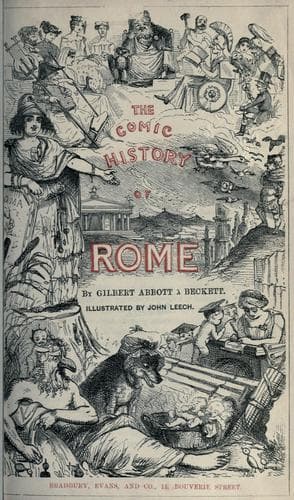
The Comic History of RomeÀ Beckett, Gilbert Abbott
History
The Comic History of Rome
À Beckett, Gilbert Abbott
Rome -- History -- Humor; Wit and humor, Pictorial
The patricians, however, were not allowed to exercise their tyranny
always without resistance; for, if their conduct was revolting to human
nature, it was to be expected that human nature would revolt against
them when opportunity offered. An instance occurred during the
Consulship of Appius Claudius, who had been elected by the senate, and
who, wishing to levy troops, caused the names of all the men between
eighteen and forty-five to be called over in a list, which furnished the
materials for enlistment. Amongst the names was that of Publilius
Volero, who had formerly held a commission as a centurion, or captain;
and, being now selected to serve as a common soldier, declared
indignantly that rather than go as a private into the ranks, he would
continue in a private station. Publilius, in fact, kicked violently
against the orders of the Consul, and being a man of very powerful
stamp, it was felt that when Publilius kicked in earnest, there was
something on foot that it was not easy to contend against. Appius
intimating that the Consuls must be obeyed, desired one of the lictors
to do his duty; when Volero, being a strong and robust man, received the
lictor with open arms, and lifting him from the ground, gave him a
setting down that shook the nerves of the astonished officer. Having
thrown the lictor on the ground, where the unhappy functionary took his
own measure, instead of carrying out those of his superiors, Volero
threw himself on the public, upon whom he made a very strong impression.
[Illustration: A Lictor is sent to arrest Publilius Volero.]
Publilius from this moment had considerable weight with the plebeians,
who made him one of their Tribunes; and he at once proposed a large
measure of reform in the mode of electing those officers. He suggested
an extension of the suffrage, by giving it to the tribes instead of the
centuries; and public meetings were got up in support of the project.
These meetings were attended by the patricians, and disturbances ensued,
owing to the attempts of one party to put the other party down; for
public discussion in all ages seems to have been conducted on the
principle that it is to be all on one side, and that any opinion opposed
to that of the majority is not to be listened to. When the strength of
lungs happens to be with the party having the strength of argument,
there is not much harm done; but as the patricians and plebeians
mustered in nearly equal numbers at the meetings alluded to, personal
altercations frequently took place; and the Tribunes as well as the
Consuls sent their respective officers to arrest each other.
Public-domain text, read in full here on John Shaqi.
Reviews
Reviews
No reviews yet
Be the first to share your thoughts on this work.
Elsewhere in the archive
Join the Discussion
Join the discussion
Sign in to leave a comment or review.
Sign InorCreate an account