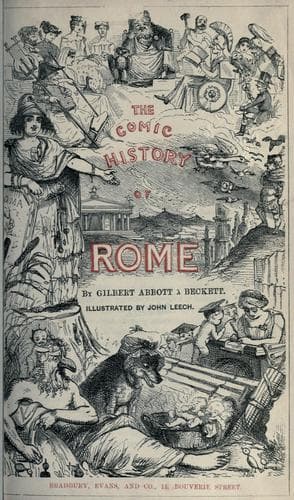
The Comic History of RomeÀ Beckett, Gilbert Abbott
History
The Comic History of Rome
À Beckett, Gilbert Abbott
Rome -- History -- Humor; Wit and humor, Pictorial
At length Lætorius, who had been elected as the colleague of Publilius
Volero, marched into the Forum with an armed force, determined that he
would that morning carry the day; and as he drew his sword, he declared
he would go through with it. The patricians, losing their own
resolution, offered to agree to any that he might propose; but, refusing
to trust them, he took possession of the Capitol, as a guarantee for the
fulfilment of their promise. The _Lex Publilia_ was accordingly passed,
to the great annoyance of Appius, who always treated the plebeians as if
different sorts of clay, as well as different moulds, were employed by
Nature in her great man--ufacture. When his year of office was over, he
was impeached by the Tribunes; but on the day when the trial ought to
have come on, the worldly trials of Appius were all past, for he died
the night before the cause stood for hearing. Posterity has agreed on
the verdict which the judges were not required to pronounce; and it has
even been said that he fell by his own hand, in consequence of his sense
of guilt preventing him from knowing how to acquit himself.
To add to its troubles, Rome was visited by a double plague, in the
shape of an external foe and an internal pestilence. The enemy having
approached the gates of the city, the country people had taken refuge
inside the walls, bringing with them their cattle in such numbers that
the place was literally littered with pigs, while the oxen and sheep
were packed in pens to an extent of which our own pen can furnish but a
faint outline. The summer was at the height of its heat, and the
sufferings of the poor dumb animals, as they lost their fat, and met
their fate, were enough to melt not only a heart of stone, but many a
stone of suet. The foe, fearing from the pestilence a plaguy deal of
trouble, broke up their camp; and Rome was allowed to enjoy an interval
of peace, though disease did more havoc than might have been expected at
the hands of an enemy.
We now come to the legend of Cincinnatus; and though it is no better
than a legend, which, as the smallest student will be aware, is so
called from _legendum_, a thing to be read, we must proceed upon the
assumption that, as it is a thing to be read, it is _à fortiori_ a thing
to be written. Lucius Quinctius, surnamed Cincinnatus from his curly
locks--for nature had dressed his hair to a turn--was of a high
patrician family. He passed his life as a country gentleman occupying
his own estate, and occupying himself in looking after it. His land, it
must be admitted, was better cultivated than his manners, which were
haughty and imperious. His virtues were all of the domestic kind; he was
equally attached to his wife and his farm, and he was an excellent
husband, as well as a good husbandman.
[Illustration: Cincinnatus chosen Dictator.]
Public-domain text, read in full here on John Shaqi.
Reviews
Reviews
No reviews yet
Be the first to share your thoughts on this work.
Elsewhere in the archive
Join the Discussion
Join the discussion
Sign in to leave a comment or review.
Sign InorCreate an account