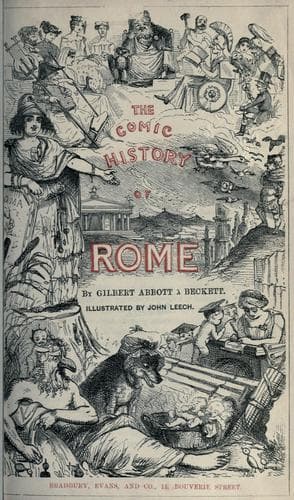
The Comic History of RomeÀ Beckett, Gilbert Abbott
History
The Comic History of Rome
À Beckett, Gilbert Abbott
Rome -- History -- Humor; Wit and humor, Pictorial
By the second table, it was justifiable to kill a thief in the night;
but a person robbed in the day was to have the thief as his slave; a
privilege equal to that of being allowed to take into your service, as
your page, the urchin who has just picked your pocket. Such an exploit
would no doubt indicate a smart lad, and, in order to make him literally
smart, the Roman law, in the spirit of our Juvenile Offenders Act,
ordered the knave a whipping.
The third table was in some respects an interest table; for it
prohibited the taking of more than 12 per cent. on a loan; but if a
debtor did not pay within thirty days, he might be bound with chains; an
arrangement by which his exertions to get out of difficulty must have
been grievously fettered. Having been made to enter into these
unprofitable bonds for sixty days, the debtor, if his creditors were
more than one, might have been divided between them; but human nature
must have found it difficult, under such circumstances, to declare a
dividend.
The fourth table seems hardly to have a sound leg to stand upon; for it
gave a father the right of life and death over all his children,
together with the privilege of selling them. To prevent a parent from
pursuing a disgraceful traffic in a series of alarming sacrifices of his
family stock, he was not permitted to sell the same child more than
three times over, when the infant was permitted to go into the market on
his own account, free of all filial duty.
The fifth table related to the estates of deceased persons; and if a
freedman died without a will or a direct heir, the law provided for the
distribution of his goods without providing for his family. Fallacious
hopes among poor relations were checked by handing over to the patron
all that remained; and thus the client may be said to have been subject
to costs, even after the debt of nature had been satisfied.
In the sixth table, there is nothing worthy of remark; but the seventh
guards against damage done by quadrupeds, and not only meets the old
familiar case of the donkey among the chickens, but declares that any
one wilfully treading on a neighbour's corn shall pay a suitable
penalty.
Agriculture was protected by making it a capital offence to blast by
incantation another's wheat; so that had the farmers of the day moaned
over each other's ruined prospects as they have done in more recent
times, performing a sort of incantation by singing the same old song of
despair, they might have been liable to lose their heads in the literal
as well as in the intellectual sense of which the phrase is susceptible.
By the same table, a man breaking another's limb was exposed to
retaliation; and a simple fracture was compensated by a simple fracture,
though the parties were allowed to compound if they preferred doing so.
Public-domain text, read in full here on John Shaqi.
Reviews
Reviews
No reviews yet
Be the first to share your thoughts on this work.
Elsewhere in the archive
Join the Discussion
Join the discussion
Sign in to leave a comment or review.
Sign InorCreate an account