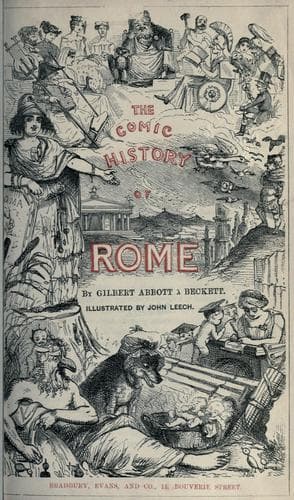
The Comic History of RomeÀ Beckett, Gilbert Abbott
History
The Comic History of Rome
À Beckett, Gilbert Abbott
Rome -- History -- Humor; Wit and humor, Pictorial
The eighth table was equivalent to a Building Act; and by providing a
space of two feet and a half between house and house, it prevented
collisions among neighbours; while the fruit dropping from one person's
tree into another's garden, fell by law into the hands of the latter.
The purity of justice was provided for by the ninth table, which ordered
the execution of a judge who accepted a bribe in the execution of his
office. It inflicted the same penalty on a corrupt arbitrator, or--that
greater traitor still--the wretch who should deliver up a Roman citizen
to the enemy.
The tenth table might teach a lesson to our own enlightened age, in
which it is too generally the custom to waste in hollow and costly
ceremonies over the dead, much that might be made serviceable to the
living. More than twenty centuries have passed since the Roman
law-makers, seeing how mourners might be caught by the undertakers in the
traps and trappings of woe, limited to a certain sum the costs of a
funeral. The outlay upon the "infernal deities," to whom sacrifices were
made in those days, and to whom, therefore, we may compare the black
job-masters of our own time, was also reduced to the very lowest figure.
In measures of health the Romans were equally in advance of us; for we
still accumulate our dead in the grave-yards of our towns, though by the
laws of the twelve tables, burials within the city were prohibited.
The eleventh and twelfth tables have come down to us in such mere
fragments, that it is difficult to make up an entire leaf from both of
them put together. To the eleventh, is attributed the aristocratic
provision against marriages between the patricians and the plebeians;
but as the law could not always prevent a flame, it was at last found
expedient to allow a match which was permitted five years later by the
Lex Canuleia.[19]
Such is a brief account of the Laws of the Twelve Tables; which although
cut up by the shears of time into very little bits, say much, in broken
sentences, to the honour of their authors. Even as late as the days of
Cicero, it was a part of a boy's education to learn these laws as a
_carmen necessarium_--or necessary verse--though they were not
necessarily in verse at all; for the better opinion is, that they were
all in prose, and that they were, in fact, as free from rhyme as they
were full of reason.
Public-domain text, read in full here on John Shaqi.
Reviews
Reviews
No reviews yet
Be the first to share your thoughts on this work.
Elsewhere in the archive
Join the Discussion
Join the discussion
Sign in to leave a comment or review.
Sign InorCreate an account