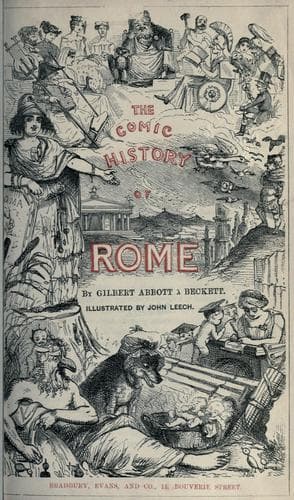
The Comic History of RomeÀ Beckett, Gilbert Abbott
History
The Comic History of Rome
À Beckett, Gilbert Abbott
Rome -- History -- Humor; Wit and humor, Pictorial
A centurion, named Virginius, had an only daughter, named Virginia, whom
her father, with a want of caution pardonable, perhaps, in a widower,
permitted to go backwards and forwards alone through the public streets
to a private day-school.[20] The young lady, in all the playful
innocence of sixteen, was in the habit of dancing and singing along the
thoroughfare, when the smallness of her feet, and the beauty of her
voice, struck the eye and ear of Appius. According to some authorities,
Virginia was attended by a nurse-maid; but it is scarcely necessary to
remark, that the same fatal fascination, which in military
neighbourhoods attracts female attention from children that ought to be,
to men that are, in arms, was no less powerful in the Via Sacra than in
Rotten Row,--by the banks of the Tiber, than on the shores of the
Serpentine. One morning, as Virginia was passing through the
market-place, on her way to the seminary, with her tablets and
school-bag--or more familiarly speaking, her slate and satchel--on her
arm, a minion, under the dominion of Appius, seized an opportunity for
seizing the maiden by the wrist. The nurse was either absent, or more
probably talking to one of the officers on duty round the corner; for
the fasces were as irresistible to the female servants of the day, as
the honied words and oilskin capes of a similar class of officials at a
much later period. Virginia screamed for assistance, and they only who
have heard the cry of a female in distress, can imagine the shrillness
of the shriek that rang through the market. Marcus--for such was the
minion's name--was instantly surrounded by a circle of respectable
tradesmen, who knew and desired to rescue Virginia. The smith, though he
had other irons in the fire, left his bellows to deal Marcus a blow;
the butcher, with uplifted cleaver, was preparing a most extensive chop;
and the money-changer was just on the point of paying off the ruffian in
a new kind of coin, when he declared Virginia to be his slave, and
announced himself as the client of the dreaded Appius. At this
formidable name, the smith's work seemed to be done, the butcher became
a senseless block, and there was a sudden change in the note of the
money-changer.
Public-domain text, read in full here on John Shaqi.
Reviews
Reviews
No reviews yet
Be the first to share your thoughts on this work.
Elsewhere in the archive
Join the Discussion
Join the discussion
Sign in to leave a comment or review.
Sign InorCreate an account